In Nexus, Yuval Noah Harari frames AI as a historical rupture—a leap from human-directed information systems to what he calls an “alien intelligence” that is “capable of making decisions and generating ideas by itself.” He describes this shift as “a completely new kind of information network… controlled by the decisions and goals of an alien intelligence.” In doing so, Harari casts AI as an autonomous agent—one with independent goals and the power to shape society. He warns that such systems may sever humans from the center of epistemic and political power.
This framing—what we might call the Harari Fallacy—is compelling, but in a crucial way, misleading. Harari rightly captures the scale of transformation. But by casting AI as external, he obscures its recursive and embedded influence. AI is not a foreign agent; it is a system born from within our institutions. A shift more intimate, and arguably more dangerous.
AI isn’t just part of the institutional fabric. It is becoming the logic that designs the fabric itself.
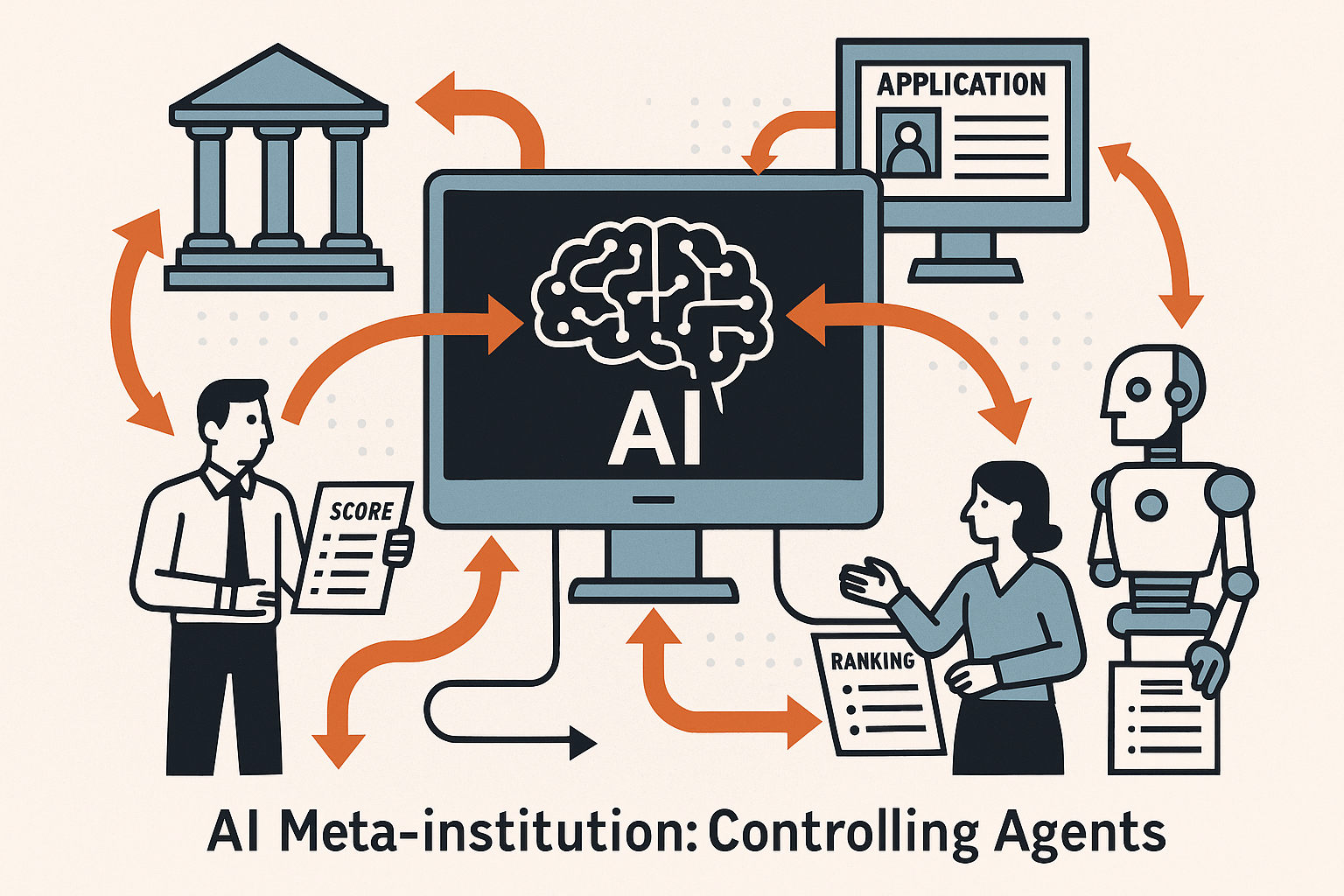
AI today is not merely a tool. Not merely an agent. Nor just an institution in the bureaucratic sense. It has become a meta-institution: a designer and controller of other agents—human and organizational. It configures evaluators, retrains bureaucrats, rewrites rules, and subtly reshapes how judgment is encoded across domains. It doesn’t just automate decisions. It restructures who gets to decide and how.
This essay builds on Harari’s provocation but reframes AI not as an independent actor, but as a meta-institution embedded in our institutional fabric. In doing so, AI is not just automating decisions—it is reshaping the sociotechnical regime: the interlocking system of technologies, norms, routines, and power relations that govern institutional behavior.
This argument draws from a broader intellectual tradition—Bruno Latour, James C. Scott, and Shoshana Zuboff among them—who show how power often hides in process, not in persons. While this essay focuses on how those dynamics play out in practice, a future post will unpack how their theories help illuminate the architecture of AI’s influence.
We will follow a fictional example—InnovaCorp, a mid-sized tech firm adopting an AI hiring platform—to illustrate how these dynamics unfold.
From Alien Intelligence to Recursive Infrastructure
AI is not just an agent. It’s the author of agents’ scripts.
Harari characterizes AI as an autonomous decision-maker—an agent. But agents operate in environments. What AI increasingly does is create the environment that other agents operate in.
At InnovaCorp, HR initially adopts AI to streamline hiring. It assigns candidate scores based on historical “success” data. But soon, hiring managers began to rewrite job descriptions to better attract high-scoring candidates. Over time, the algorithm isn’t just filtering candidates—it’s shaping the definition of what the company thinks a good candidate is.
This is recursive infrastructure: institutions reacting to outputs that they helped produce, now restructured by machine logic.
Redesign, Not Just Drift
AI does not just decide outcomes. It decides what counts as a decision.
At InnovaCorp, optimization gradually becomes governance. Hiring managers begin selecting candidates not on qualitative impressions, but based on AI-generated scores. The metric becomes the mission.
This shift changes not only who is hired but also how jobs are defined, how performance is evaluated, and how internal accountability is structured. Candidates start optimizing their resumes for the algorithm—stuffing them with the right keywords, formatting them for machine parsing, shaping their experience to match historical patterns. The AI system, designed to reflect institutional values, begins to redefine them.
This is not a case of automation drifting into misuse. It is an active reprogramming of institutional logic. The AI, while seemingly neutral, becomes the architect of institutional priorities.
And this is not confined to fiction. At Amazon, an AI recruiting tool learned to penalize resumes containing the word “women’s,” effectively institutionalizing gender bias based on past data. At HireVue, video-based assessments claimed to score “communication” and “learning ability” by analyzing facial expressions and voice tone—until public scrutiny forced the company to remove facial analysis from the system. And in the class-action lawsuit Mobley v. Workday, plaintiffs allege that Workday’s AI system systematically discriminated against older candidates, potentially affecting millions. These examples show how AI tools can silently reshape what institutions prioritize, until challenged by public or legal intervention.
Governance Failure at the Meta-Level
The danger isn’t that AI becomes intelligent. It’s that institutions stop needing to be.
Consider a candidate rejected by the system. She had a strong but unconventional background—community organizing, international work, and a nonlinear career path. But she lacked the calibrated indicators the model preferred. When she inquires, no one at InnovaCorp can explain the decision. It is buried in a stack of features, weights, and patterns. There is no appeal. No clarity. No deliberation.
This is a governance failure not just of an algorithm, but of the institution that outsourced its judgment. Where once institutions justified decisions, they now defer to scores. The ritual of reasoned explanation—central to legitimacy in public and private decision-making—disappears. What remains is an output.
This transformation isn’t hypothetical—it’s already under regulatory scrutiny.
What Is To Be Done: Designing for Meta-Governance
To govern AI, we must govern how AI governs us.
We can no longer think of algorithmic oversight as a matter of model accuracy alone. We must consider how institutions structure themselves around AI—and what it would take to ensure that those structures remain legible, contestable, and aligned with human values.
This means building systems that support contestation: not just accepting or rejecting decisions, but interrogating them. Imagine if every automated hiring decision were accompanied by a counterfactual: “Your score was 85. Had you listed ‘Project Leadership’ under ‘Cross-Functional Initiatives,’ your score would have been 95.” This reframes opacity as a design choice, not a necessity.
It also means preserving legibility: institutions should disclose what their AI systems are optimizing for, what data they are trained on, and what known biases they carry. A hiring algorithm might come with a visible tag: “Optimized for: Speed-to-Hire. Trained on: 2018–2022 employee data. Known exclusions: nontraditional career paths.” That alone would shift how we perceive and engage with algorithmic outputs.
And finally, we must reinforce institutional agency: decisions made by AI should be overrideable by humans with structured justification. This keeps humans in the loop, not as mere validators, but as agents capable of moral and contextual judgment. If AI makes governance efficient, it must not make it unaccountable.
These are not just aspirational ideas—they are design principles, and increasingly, they are becoming formalizable. In 2024, the EU’s AI Act formally classified AI systems used in employment, education, and credit as “high-risk,” mandating transparency, data quality, human oversight, and documented accountability. In New York City, Local Law 144 now requires annual bias audits for automated hiring tools, with public disclosure and candidate notification. And in the U.S., the White House’s Blueprint for an AI Bill of Rights urges protections against algorithmic discrimination and pushes federal agencies to enforce civil rights standards even when decisions are made by machines. In my own research on algorithmic fairness, feedback, and strategic behavior, I explore how institutions can navigate these trade-offs in noisy, biased environments. But the key is to treat AI not merely as a system, but as a governance substrate—a meta-institution whose influence must itself be governed.
The Broader Point
The question is no longer whether AI governs. It’s how well it does it—and for whom.
AI systems are already performing core institutional functions: filtering applicants, shaping curricula, allocating credit, and moderating speech. They are evaluators, gatekeepers, and norm-setters. But they do so without transparency, without recourse, and often without awareness of their own normative consequences.
We are not governed by alien minds. We are governed by recursive procedures—by optimization routines and feedback loops that encode incentives we do not always see.
From resume filters that punished women’s chess captains to video interviews that claim to quantify your “communication ability” from facial tics, the story of AI’s rise isn’t one of intelligence alone—it’s one of silent institutional redesign.
We are not just delegating decisions—we are delegating the power to define what a decision is.
The real question, then, is not whether AI should have institutional power. It already does. The question is: what kind of meta-institution are we allowing it to become—and who gets to decide?
Sources and Further Reading
- Yuval Noah Harari, Nexus: A Brief History of Information Networks from the Stone Age to AI (2024)
- James C. Scott, Seeing Like a State: How Certain Schemes to Improve the Human Condition Have Failed (1998)
- Shoshana Zuboff, The Age of Surveillance Capitalism: The Fight for a Human Future at the New Frontier of Power (2019)
- Bruno Latour, Science in Action: How to Follow Scientists and Engineers Through Society (1987) and Pandora’s Hope (1999)
- Amazon’s resume screening AI: Jeffrey Dastin, “Amazon Scraps Secret AI Recruiting Tool That Showed Bias Against Women,” Reuters, Oct 2018. Link
- HireVue facial analysis: Drew Harwell, “A Face-Scanning Algorithm Increasingly Decides Whether You Deserve the Job,” Washington Post, Oct 2019. Link
- Workday lawsuit: Link
- NYC Local Law 144 (2023): Full text
- EU AI Act (2024): Summary
- Blueprint for an AI Bill of Rights (2022): White House OSTP
For more of my work, visit my academic website.
Discover more from Algorithms, Nature, and Society
Subscribe to get the latest posts sent to your email.
