How Machines Learn to Write

From Shannon’s prediction game to modern transformers—and what gets lost in meaning

The Mysteries of Words

A few years ago, I sat in a dissertation defense for a student working on language models, and something quietly unsettled me. He was explaining “attention mechanisms,” showing how his system could summarize documents in perfect English. I remember watching the examples scroll by, line after line, unlike earlier machine-generated texts, carrying no seams.

After the defense, there was a small celebration. Over coffee and cake, I asked colleagues where this whole idea had begun. Someone mentioned ELIZA: the first chatbot that simulated conversation. ELIZA’s famous DOCTOR script mimicked a psychotherapist, reflecting users’ words back at them and so creating the illusion of understanding.

It didn’t have a model of meaning; it was based on pattern-matching and substitution. And yet many people responded as if it did. That strange human tendency to attribute feeling to a simple program was later called the ELIZA effect. Curious, I traced the thread further back and realized that ELIZA stood on a foundation laid much earlier by Alan Turing. Turing had in fact written two remarkable papers just after World War II.

In 1948, in Intelligent Machinery, he sketched what he called an “unorganized machine,” a crude model of the infant brain. Its wiring was initially random, but through reward, punishment, and random exploration, it could be “educated” into a universal computer. To prove its worth, he proposed a set of benchmark tasks: games like chess and cryptography as easier challenges, mathematics and translation as harder ones, and at the very top, the learning of natural language. Already, he sensed that teaching a machine language would be the ultimate test.

Two years later, in 1950, in Computing Machinery and Intelligence, he posed his famous provocation: not “Can machines think?” but whether they could succeed in the imitation game, what we now call the Turing Test. Once again, language was the centerpiece. He imagined training a machine as one might teach a child, through interaction, naming, and correction.

In hindsight, ELIZA was almost a toy realization of Turing’s challenge: a machine producing conversation that, for some, passed as human. It was a small step, but a definitive one on the march toward what we now call artificial intelligence. That was the lineage: from Turing, through ELIZA, to the models I had just seen.

The resemblance was striking, but also disorienting. It blurred the boundary between words that merely followed rules and words that carried meaning. The harder task was never finding the words, but shaping the essence they had to carry. Unlike the demo I saw, which simply strung together the most probable words, I faced a different kind of struggle: I knew the words, but the felt essence wasn’t there yet. That quiet, internal wrestling, the pause and reshaping before meaning lands, was absent in the polished texts before me.

This is not merely a technical matter of algorithms. Language is bound up with social practice, with the rituals and repositories by which communities make sense of the world. A sentence does more than map signs to ideas; it declares, commands, consoles, jokes, curses, remembers, and binds people together in common projects. Across cultures and centuries, in oral performance and written text, language accumulates authority and history: it carries law, theology, love letters, treaties, protests, prayers, jokes, and recipes.

I grew up with the Ramayana and the Mahabharata, not as entertainment but as living traditions: vast conversations full of moral dilemmas, strategic debates, and philosophical inquiry. The Bhagavad Gita, nested inside the Mahabharata, is itself a dialogue about duty and liberation that still guides millions. Later, in English, I discovered Shakespeare’s soliloquies and the playful wit of Pygmalion. Across these forms, language is never merely syntax or sequence; it is a vessel through which thought, memory, and moral imagination endure.

But language is not the only such vessel. Music can convey emotion more directly than a sentence. A painting can express what words cannot. Athletes speak through rhythm and gesture; mathematicians through symbols and proof. These are all languages in a broader sense: systems of signs that carry meaning.

What sets natural language apart is its paradoxical combination of simplicity, fragility, and reach. Compared to music, it is a sparse medium. Just strings of symbols. And that simplicity makes it radically fragile: a comma, a tense, or a single word can tilt the whole meaning. Yet because it can describe, question, command, or console, its coverage is unmatched. Perhaps this is why Turing placed language at the pinnacle of machine intelligence: to master something so lean, so delicate, and so general would be to master almost anything.

That ambition, once only theoretical, suddenly felt realized when ChatGPT arrived. What had once been a curiosity in labs and conference rooms suddenly erupted into daily life. A seminar-room marvel became a household word. Classrooms, newsrooms, law firms, and living rooms all found themselves confronted by a machine that could speak in polished paragraphs. Students turned in assignments written by it, professionals drafted memos with it, and friends sent poems and prayers through it. Headlines proclaimed that human thought itself had been hacked.

The effect was electric, unsettling, and irresistible: a machine producing not just a clever reply but a torrent of fluent language on command: text that could mimic styles, explain theories, or console in grief. Where earlier chatbots exposed their seams within a few exchanges, this one could sustain entire conversations, sounding by turns confident, witty, or wise. For many, it felt like crossing a threshold: as if the capture of language, the vessel of our thought, memory, and imagination, had also led to the capture of thought itself.

But had it?

Sign up here (it’s free) to read the full essay: https://nisheethvishnoi.substack.com/

The Myth of Superintelligence

Why AI Won’t Transcend Us—But the Race to Superintelligence Might Redefine Us

At the dawn of the nuclear age, a handful of scientists raced to split the atom. Behind closed doors, they unlocked forces of unimaginable power—capable of reshaping geopolitics, ending wars, or ending the world. The stakes were enormous. The oversight was minimal.

As the mushroom cloud rose over the New Mexico desert, Oppenheimer recalled the Bhagavad Gita:

“Now I am become Death, the destroyer of worlds.”

It was not just a scientific breakthrough—it was a civilizational rupture, and a moment of spiritual reckoning.

Today, we stand at a similar threshold—but this time, the weapon isn’t atomic, it’s epistemic: the power to define, displace, and dictate what counts as intelligence.

A handful of billionaires now race to transcend the very concept of mind.

This is the race to superintelligence—not just a technological contest, but a geopolitical gamble disguised as an AI boom. It unfolds in boardrooms and GPU clusters, driven by speculation, ambition, and fear.

The headlines scream the urgency: Meta reportedly offered $32 billion for Safe Superintelligence, a small startup co-founded by Ilya Sutskever. Sam Altman claimed rivals are dangling $100 million signing bonuses to lure away OpenAI talent working on superintelligence. And Elon Musk, for instance, has predicted that superintelligence will arrive within six months.

This isn’t science fiction. It’s a live experiment on humanity, with no brakes or off switch.

And these aren’t novelists. They’re the very people shaping global AI policy, capital flows, and public belief. Their words fuel markets, realign talent, and reframe speculation as inevitability.

The story being told is simple: AI will soon surpass us—reason better, learn faster, and predict more precisely. It will understand us, outgrow us, perhaps even save us.

And to be fair, the AI race has already delivered extraordinary breakthroughs. We now have AI systems that can predict protein structures, accelerate vaccine development, improve weather forecasting, and translate languages in real time. They are expanding access to healthcare diagnostics, supporting education in underserved regions, and helping marginalized communities organize and advocate. In the right hands, it’s not just advancing knowledge—it’s redistributing it.

But what if the real story is something stranger? What if these machines aren’t transcending us—but are reflecting our biases, and in doing so, trapping us within a narrative that is narrow, selective, even grotesque?

Just this week, headlines claimed AI is close to solving the Navier–Stokes problem—one of mathematics’ greatest challenges. In truth, it was mathematicians guiding DeepMind—not AI solving math, but humans exploring with new tools. Still, the myth headlines: “AI Solves”.

This is the pattern. AI can accelerate exploration—but it does not choose the problem, define what counts as a solution, or frame the space in which solutions are sought. Those decisions—what matters, what’s possible, what’s meaningful—still come from human minds.

Yet the headlines collapse that distinction. They turn collaborative amplification into autonomous achievement. And in doing so, they reinforce the myth.

The myth of superintelligence—the belief that machines will soon outthink us across all domains—has become the defining narrative of the AI era. It drives billion-dollar valuations, existential headlines, and a mood that swings between prophecy and panic.

At its core is a single premise: that intelligence is measurable, stackable, and conquerable. That with enough data and compute, it will emerge—bigger, faster, better.

But intelligence cannot be reduced to a number. It is not prediction, speed, or performance. Real intelligence—whether in a brain, a slime mold, a flock of starlings, or a cello note—does not arise from accumulation alone. It comes from attunement: the capacity to notice, to reframe, to care.

This series traces the roots of the superintelligence myth—what it is, where it came from, what it obscures, and what its pursuit may cost us. It does not ask whether AI will become superintelligent, but what that belief reveals: a confusion about the nature of intelligence, and a recurring urge to centralize, rank, and control it.

This first essay unpacks the myth itself—its origins, its logic, and its consequences. The next installment begins the recovery: What is intelligence—beyond metrics, benchmarks, and brainpower? What distinguishes it from mere intellect? And why does that distinction matter now more than ever?

Read the full essay here, along with others, by subscribing (free) to The Intelligence Loop.

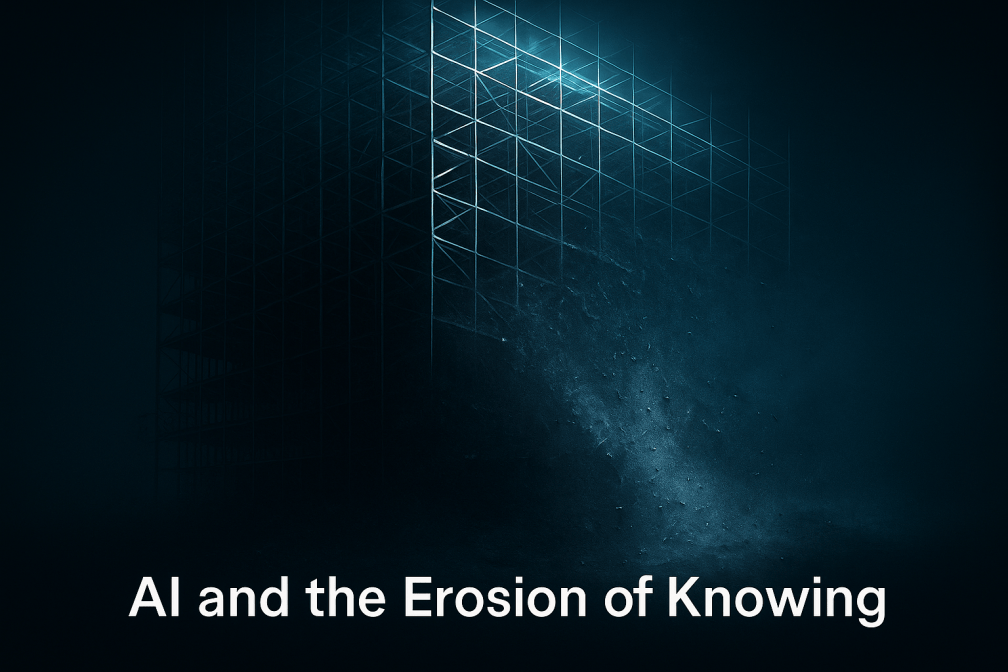
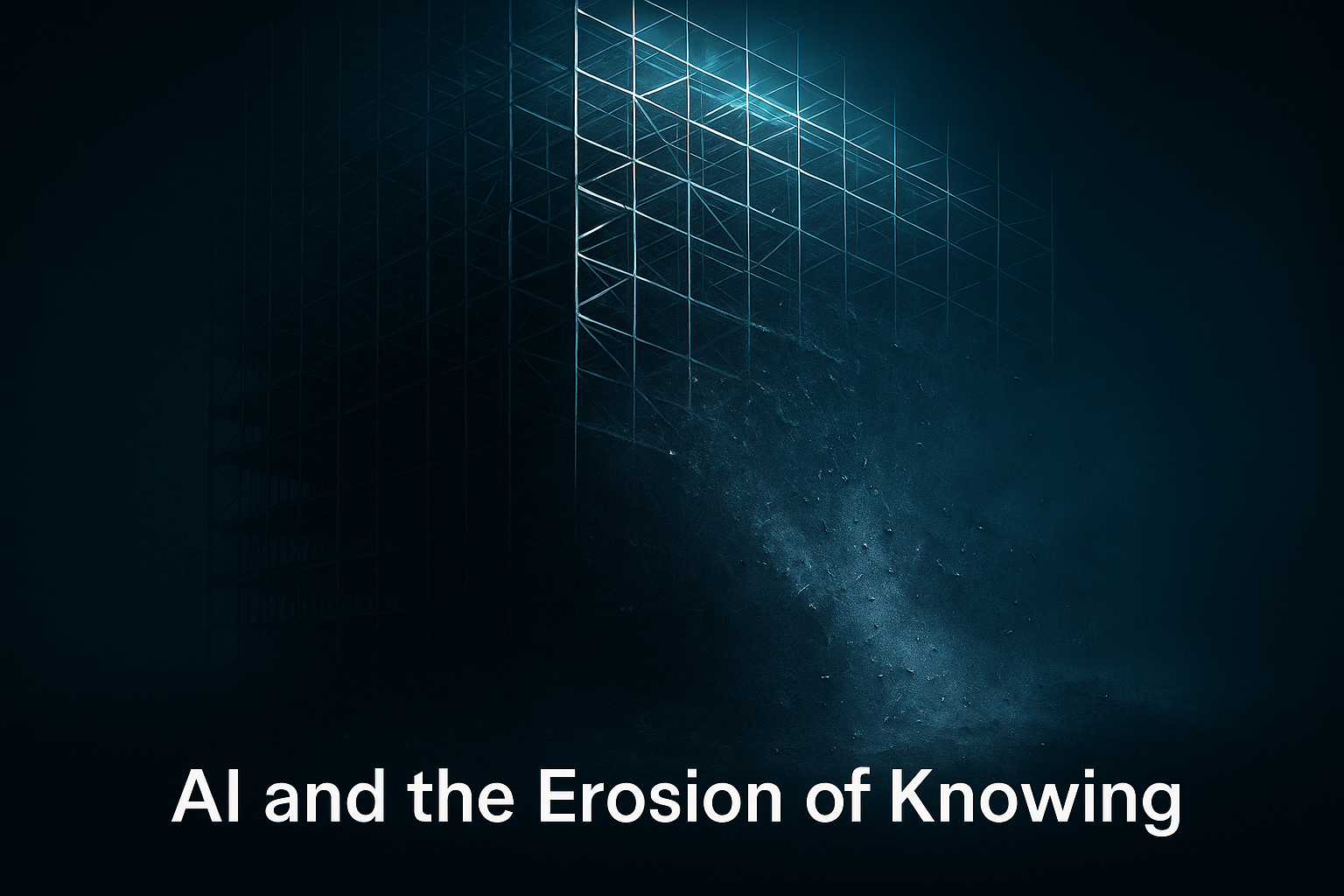
AI and the Erosion of Knowing

“The obstacle was always the path.” Adapted from a Zen proverb

In the Renaissance, apprentices learned to paint by grinding pigments, mixing oils, stretching canvas, and copying masterworks line by line. In architecture, students spent years sketching by hand before they touched a computer. In math, the best way to understand a theorem is to try to prove it yourself—and fail.

Today, that slow accumulation of competence is being replaced by a faster rhythm.

Ask an AI to write a proof, generate a building, produce an image, or answer a math question—and it will. But something essential gets skipped. And what gets skipped doesn’t just disappear. It quietly erodes.

AI gives us output without process. The result: polished answers with no foundation.

The Eroding Scaffold

Learning isn’t just about information. It’s about structure and the path you took to get there. You don’t truly understand a concept until you’ve built the scaffold it rests on—step by step, skill by skill.

Mira’s Derivative

Take Mira, a student learning calculus. She’s supposed to learn how to compute derivatives. The teacher explains the chain rule: when one function is nested inside another, you must differentiate both, in the right order. It’s abstract, so Mira does what students do—she turns to an AI tutor.

She types:

“Find the derivative of sin(x² + 3x).”

The AI answers instantly:

cos(x² + 3x) · (2x + 3)

It even offers a short explanation. Mira copies it down and moves on.

What she didn’t do:

– Simplify the inner expression.

– Apply the rule mechanically.

– Make a mistake and figure it out.

– Internalize the rhythm of composition and change.

Now fast-forward two months. Mira sees a problem she’s never encountered:

“Differentiate xᵡ.”

She freezes. No familiar template. No AI available. No internal scaffold to fall back on.

She reached the destination — but never built the path.

The skipped struggle was what encoded the concept.

Leo’s Essay

Now consider Leo, a college student writing an essay on political philosophy. He’s supposed to take a position on Hobbes’s Leviathan and argue whether absolute sovereignty is justified today.

Traditionally, Leo would:

– Clarify Hobbes’s argument,

– Develop a counterposition,

– Find textual evidence,

– Draft and revise a logical structure.

Instead, he types:

“Write a 5-paragraph essay arguing against Hobbes’ justification of sovereign power.”

The AI delivers—fluent, plausible, even citing sources. Leo pastes it in, tweaks a few lines, and submits.

A week later, he’s asked:

“How would Hobbes respond to modern surveillance capitalism?”

He flounders. The structure was never his. The reasoning was never practiced. The scaffolding was never built.

He didn’t outsource writing. He outsourced thinking.

Teachers aren’t grading the prose. They’re grading the reasoning it reveals.

Art Without Sketching, Architecture Without Lines

In design and architecture, we’re seeing the same thing. AI can generate facades, floor plans, and renders in minutes. But without grounding in scale, structure, or constraint, designs become fragile—beautiful but unbuildable. The result is a facade that ignores sun direction, a floor plan that fails fire code, and a portrait with six fingers.

In art, tools like Midjourney let users create stunning illustrations from a few words. But if you can’t draw, can you see? Can you revise? Can you critique? Can you tell what’s off?

Drawing is not just a means of production—it’s a way of learning to notice. Line by line, it teaches scale, proportion, balance, rhythm. Without that training, feedback becomes guesswork. Revision becomes roulette.

When the tool does the shaping, the human stops developing the eye.

And when the AI makes a mistake—one that’s subtle, structural, or compositional—there’s no foundation to catch it. You don’t just lose the sketch. You lose the ability to tell when something is wrong.

Oversight Collapse

AI doesn’t reason — it samples.

When a model like GPT writes a paragraph or answers a question, it isn’t deriving a conclusion from first principles. It’s drawing from a probability distribution — choosing what sounds most plausible based on past data.

The result? Output that feels fluent — but isn’t guaranteed to be correct.

That’s what makes AI mistakes dangerous. They’re not just wrong. They’re plausibly wrong — errors with the gloss of insight. And if we’ve skipped the scaffolding, we can’t tell the difference between coherence and truth.

This is the tipping point: when we’re still “in the loop,” but can no longer verify what we see. We’ve become fluent — but not competent. You look like you’re in control. But you’re just along for the ride.

And the risk isn’t limited to math or logic. In “wicked” domains — ethics, design, law, writing — there may be no single right answer. What matters is the ability to justify, adapt, revise, and notice what doesn’t quite fit.

That capacity comes from friction — from having built the internal scaffold of reasoning.

AI gives us output. But it skips the reasoning. It removes the friction — and with it, the growth.

From Work to Erosion

In a recent post, I argued that AI is reshaping work not by replacing entire jobs, but by separating judgment/decision from execution/action. Tools like GPT, Copilot, and dashboards take over action-level tasks. But what remains human is the ability to frame problems, make judgments, and verify outcomes.

In that example, Ada, a software engineer, wasn’t made obsolete. Her job changed. Execution was automated. Judgment was not.

But here’s the deeper risk: what if using AI to execute also erodes our ability to decide?

That’s the dynamic explored here. When AI lets us skip foundational steps—whether in calculus, writing, or design—it removes the very scaffolding that enables judgment to form.

At first, it feels like acceleration. But over time, it becomes erosion.

The erosion of action-level skill becomes the erosion of decision-level agency.

What Can Be Done

The goal isn’t to abandon AI. It’s to use it without losing ourselves.

That means:

– Choosing tools that show their work, not just their output.

– Practicing skills we no longer “need,” because they still underpin everything else.

– Teaching not just what to do, but how to decide, how to verify, and how to notice what’s missing.

What’s at stake isn’t just productivity. It’s agency.

Final Thought: The Skills We Skip Are Still Ours to Build

When we let AI do the scaffolding for us, we don’t just skip steps—we weaken the very structures that make thinking, reasoning, and creating possible.

The skills we skip don’t vanish. They decay. Quietly. Until we need them—and find we’ve forgotten how they worked.

So yes, use AI. But build the scaffold anyway.
Because the point isn’t just getting it right — it’s still knowing what right looks like.

That’s the kind of knowing worth protecting.

Originally published in this Substack post.

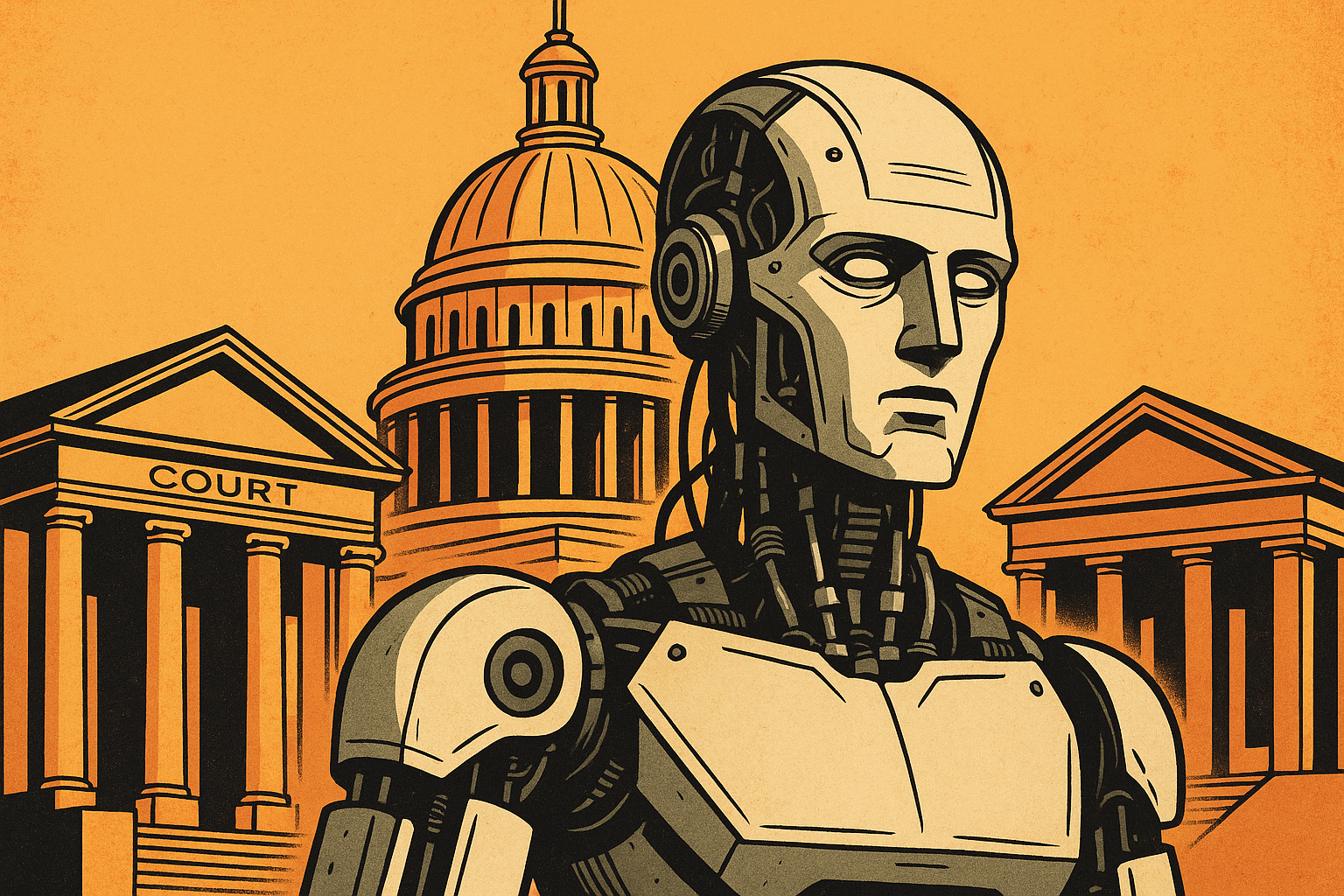
AI Are the New Institutions

How algorithms gained decision-making power—and what they replaced

In my previous post, I argued that AI systems—particularly those built on large models—are no longer just tools. They are becoming institutions.

Not in the legal sense. But in function.

They structure judgment, allocate opportunity, and shape legitimacy, just as courts, schools, or hiring boards once did.

This post explains what that claim means in practice. Not through abstraction, but through concrete, recent events.

When I say “AI,” I don’t mean a single system. I mean a distributed set of deployed models—language models, scoring tools, surveillance networks—that now act with institutional authority in many parts of life.


What makes something an institution?

Institutions are not just buildings or bureaucracies. They are systems of trust and authority.

They determine:

  • Who gets hired.
  • Who is heard.
  • Who is protected or punished.
  • And who gets left out.

They operate over time. They are accepted, contested, appealed to.

And now, AI systems are being inserted into exactly these roles.


From automation to judgment

A2025 Australian study led by researchers at the University of Technology Sydney found that AI hiring systems widely used in the private sector were systematically discriminating against women, people with disabilities, and candidates with non-standard accents.

Some systems analyzed facial expressions during interviews, penalizing applicants who didn’t smile “appropriately.” Others struggled with speech patterns from non-native English speakers, or penalized pauses—often flagging neurodivergent candidates as “low energy.”
Most troublingly, many of these systems were trained on U.S. resumes and corporate data, leading to cultural mismatches in Australian hiring. (source)

The AI didn’t just screen résumés. It functioned as a hiring gatekeeper, shaping who advanced and who disappeared from consideration.


Prediction becomes policy

Los Angeles County recently launched a machine learning initiative called PREVENT to identify individuals most at risk of becoming homeless.

The system analyzes data across health records, public benefits, and eviction filings. It flags individuals for early intervention, offering rental assistance or job support—before they lose housing. (source)
In a world of limited social services, that score can determine who gets help and who doesn’t. Prediction becomes a gateway.

The model becomes a triage system, quietly encoding institutional priorities.


From oversight to automation

In 2024, New Orleans police used over 200 facial recognition cameras run by a private nonprofit to monitor and arrest suspects in real time—without public disclosure.

The system sent alerts with suspect identities and GPS locations directly to officers’ phones, resulting in at least 34 arrests—some for nonviolent offenses. (source)

This surveillance violated a 2022 city ordinance, which limited facial recognition use to violent crime investigations. Yet the system operated with full effect, effectively automating discretionary policing without accountability.


AI governs speech

For instance, in 2024, TikTok laid off hundreds of human moderators and leaned heavily on AI to enforce its content policies.

Over 150 million videos were removed in one quarter alone—more than 80% flagged automatically. (source)
Yet users have long noted that AI moderation lacks nuance, often taking down posts about trauma, race, or mental health from marginalized communities.
In response, creators began using “algospeak” (e.g., “unalive” instead of “suicide”) to evade takedowns.

When AI moderates, it doesn’t just enforce guidelines. It structures what can be said and what is suppressed.

And this is just the tip of the proverbial iceberg.


The power without the process

These systems don’t gain authority from constitutional law or public oversight.

They derive it from performance (or efficiency):

  • “It works.”
  • “It scales.”
  • “It predicts better than humans.”

But once adopted, their outputs become binding.
And there is often no one to appeal to.

The judgment is made before the human arrives.
And often, the human defers to it.


Why this matters

When institutions were flawed, we could appeal. Argue. Dispute. Reform.

With AI systems, we often don’t know the decision was made. Or we mistake it for truth.

That’s what I mean when I say: AI systems are becoming institutions.
Not because they were designed to be—but because they function like ones.

They make judgments. They allocate resources. They shape legitimacy.
But unlike human institutions, they offer no explanation, no transparency, and no path for redress.

Originally published on Substack: AI Are the New Institutions.