Can AI Know Infinity?

What mathematics reveals about the limits of today’s AI — and why AGI remains distant

“An equation for me has no meaning unless it expresses a thought of God.” — Srinivasa Ramanujan

When I was in high school, my mother gifted me a copy of The Man Who Knew Infinity. It told the story of Srinivasa Ramanujan—a self-taught genius from India whose mathematical intuition ran so deep he often described it as divine. At the time, I was just beginning to wrestle with the idea of infinity in math: infinitesimals in calculus, unbounded limits and asymptotes, the endless decimals of irrational numbers, the infinity of natural numbers, and the even stranger idea that some infinities are larger than others.

The book arrived at exactly the right moment. I was learning to manipulate infinity, but Ramanujan’s story hinted at something more: that infinity in mathematics wasn’t just a number to manage, but a realm to enter.

I didn’t just want to understand what he wrote. I wanted to understand what he understood.

That feeling—of awe, of pursuit, of reaching beyond the page—stayed with me. It led me deeper into mathematics. Later, into computer science. Two disciplines that, in many ways, shaped the intellectual landscape we now live in.

One gave us infinity—a way to think beyond the bounds of the finite.

The other gave us AI—a system that now mimics reasoning itself.

And so the question doesn’t feel abstract. It feels urgent. Can AI know infinity?

This isn’t just poetic curiosity. It cuts to the heart of one of the most charged debates of our time:

Are we on the brink of artificial general intelligence?

Some say yes — pointing to models that solve Olympiad problems, generate elegant proofs, or optimize algorithms better than graduate students. Others say not even close — citing the same models’ inability to navigate logic puzzles that a twelve-year-old can solve.

Nowhere is this tension more visible than in mathematics.

Math is the litmus test. It doesn’t bend to rhetoric. There are no blurry edges. Either a solution holds, or it breaks. Either an insight generalizes, or it falls apart.

If AI can “do math,” that’s a serious step toward general intelligence.[1]
But what kind of math? And what does “doing” mean?

Because in math, the real challenge isn’t just solving the problem.
It’s knowing what problem is worth solving.
That’s what Ramanujan saw.


The Fundamental Bug: No Inner Judge

AI today can write code, solve equations, and mimic mathematical language with fluency. But beneath the surface, there’s a structural flaw that keeps it from doing real mathematics:

It doesn’t know when it’s right.

Ask an LLM to solve a logic puzzle, and it might respond confidently with a wrong answer. Or halt prematurely. Or keep going in a direction that makes no sense.

That’s not a user interface issue. That’s the core architecture.

AI is trained to continue. Not to know.

Human mathematicians are different. We often get things wrong—but we know we’re wrong, and we keep going anyway. We chase ideas we can’t yet prove because they feel right. Ramanujan wrote down hundreds of unproven formulas; many were correct, some were not, but all reflected a deeper intuition. Even his errors were structurally suggestive.

What he had wasn’t certainty. It was a sense of what needed to exist.

AI doesn’t have that. It doesn’t feel surprise. It doesn’t experience doubt. It doesn’t recognize a dead end—or a promising mistake.

And even if we one day succeed in bolting on verifiers or theorem checkers, that won’t solve the real problem. Because we still won’t know how to program what feels right.

What makes a question beautiful? What makes a proof surprising? What gives rise to the conviction that a path—though unproven—might be worth walking?

That sense of direction is not verification. It’s vision.


What AI Can and Cannot Do

Before we can ask whether AI can know mathematics, we need to ask: what can it do?

Modern AI systems, especially large language models, have become surprisingly proficient at solving a wide range of mathematical problems — from calculus exercises to Olympiad-level inequalities, especially when scaffolded with hints or structure. But when pushed beyond the known — into abstraction, creativity, or self-directed reasoning — they falter. Spectacularly.

This isn’t just a difference in difficulty. It’s a difference in kind.

Below is a typology of mathematical reasoning — where today’s AI models succeed, and where they fundamentally break.

What AI Can Do Reliably

  1. Symbolic Procedures
    Example: Differentiate f(x)=x³sin x
    Why it works: Follows fixed rules; no conceptual insight needed.
  2. Textbook Proof Replication
    Example: Prove that the sum of two even numbers is even
    Why it works: Matches learned patterns; templates are widely available in training data.
  3. Scaffolded Problem Solving
    Example: Solve an IMO inequality when prompted step-by-step
    Why it works: Excels when nudged in the right direction; mimics known strategies.

Where AI Fails Fundamentally

These examples highlight current limits in mathematical reasoning, especially in creativity, abstraction, and structural understanding.
Note: “Why it fails” isn’t a hard boundary. It sketches a limitation, not a permanent impossibility. These assessments reflect extended hands-on work with today’s best models, and despite rapid progress, the chasms remain.

  1. Constructing Counterexamples
    Example: Give a non-abelian group of order 6
    Why it fails: Doesn’t reason structurally; often guesses without understanding.
  2. Reasoning About Parameter Families
    Example: Analyze the qualitative behavior of the cubic family x³ – ax + b
  3. Why it fails: Can’t generalize across parameters or detect qualitative shifts, like when a cubic suddenly gains extra real roots.
  4. Inventing Abstractions
    Example: Propose a unifying definition that generalizes pointwise and uniform convergence
    Why it fails: Cannot generate new conceptual frameworks; stuck within known vocabulary.
  5. Meta-Reasoning and Self-Verification
    Example: Prove that the halting problem is undecidable, or verify whether a proof by induction includes a valid base case
    Why it fails: Lacks an internal model of correctness. Confuses structural necessity with surface analogies and cannot distinguish between truth and plausibility—often producing flawed or unchecked reasoning.
  6. Forming Conjectures
    Example: Suggest a new connection between continued fractions and Pell’s equation
    Why it fails: Cannot speculate meaningfully; no sense of what’s plausible but unknown.
  7. Evaluating Elegance or Surprise
    Example: Choose between two equivalent proofs and explain which is more elegant
    Why it fails: No aesthetic filter; no intuition for simplicity, beauty, or surprise.

AlphaEvolve: Promise Without Perspective

Google’s AlphaEvolve offers a glimpse of what deeper mathematical search might look like. It generates variations of algorithms, evaluates them on benchmarks, and selects improvements that outperform prior versions.

This is more than pattern-matching. It involves testing, comparison, and iteration. In a sense, it’s a primitive form of self-improvement—a system that learns to evolve better solutions.

The upside is clear: AlphaEvolve integrates generation with verification. It doesn’t just guess — it checks. And that feedback loop is a necessary step toward deeper AI reasoning.

But even here, the process is externally grounded. AlphaEvolve doesn’t reason about why an improvement works. It doesn’t reflect on whether the solution generalizes to broader settings or whether it hints at a deeper principle.

It’s evolution without insight.

Even the selection criterion—“performs better on X”—is defined externally. The system doesn’t ask whether the improved algorithm is more elegant, or foundational, or points to a new abstraction. It lacks intentionality. It doesn’t explore the space of ideas, only the space of outcomes.

AlphaEvolve marks progress. But it hasn’t crossed the threshold. It plays with variation. But it doesn’t originate purpose.

To be fair, some approaches — like neural-symbolic reasoning or theorem-proving via language model outputs — aim to address these limitations. Yet even these remain bounded by external verification, not internal judgment.


The Apple Paper: When the Illusion Breaks

Apple’s recent research paper, The Illusion of Thinking, tested modern LLMs on classic logic puzzles—Tower of Hanoi, river-crossing tasks, and other structured reasoning challenges.

The results? Performance dropped to zero.

Children can solve these puzzles. AI could not.

Even when given the correct algorithm, models failed to apply it. They produced shorter, shallower responses as difficulty rose.

This isn’t a bug. It’s the architecture. The models do not “think.”

They simulate thinking. But they don’t test their reasoning. They don’t correct themselves. They don’t know they’re wrong.

The Apple paper exposes the limits of surface reasoning. These systems generate fluent approximations of thinking, but collapse when they need to sustain internal logic over multiple steps.

This is where the illusion breaks. Language isn’t thought. And coherence isn’t correctness.

Even defenders of AI capability concede the point: models behave like they’re “thinking” until the scaffolding is removed. The moment ambiguity, recursion, or inference is required, they flail.

It’s not a problem of scale. It’s a problem of architecture. What’s missing is persistence of thought—the ability to hold a structure in mind, test it, and revise it.

Until models can navigate ambiguity, apply rules with purpose, and revise their logic, they won’t reason. They’ll only perform the appearance of reasoning.

This failure to sustain internal logic reveals the true dividing line in mathematical thought.


Judgment Before Execution

This essay began with infinity, not because it’s hard to compute, but because it marks a deeper shift in how we think. It’s where procedure ends and judgment begins.

That’s the real fork in mathematical reasoning. Not between what’s easy or hard, but between what is given and what is constructed.

Much of mathematics isn’t about solving a problem handed to you. It’s about deciding what the problem should be. What structure is worth studying? What pattern is trying to be seen? What generalization brings clarity?

This is not a mechanical step. It’s not about plugging into a formula or applying a learned move. It’s about seeing a direction where none yet exists.

In chess, the board is fixed. In protein folding, the energy landscape is physical. But in mathematics, the terrain itself is invented. Definitions, objects, analogies — these aren’t constraints. They’re choices. The path isn’t mapped. The map is the path.

This is where AI still falters. It excels at execution — following rules, generating formal steps, even solving highly structured problems. But it lacks judgment. It does not ask whether a problem is worth solving. It does not reframe the question. It does not choose the terrain.

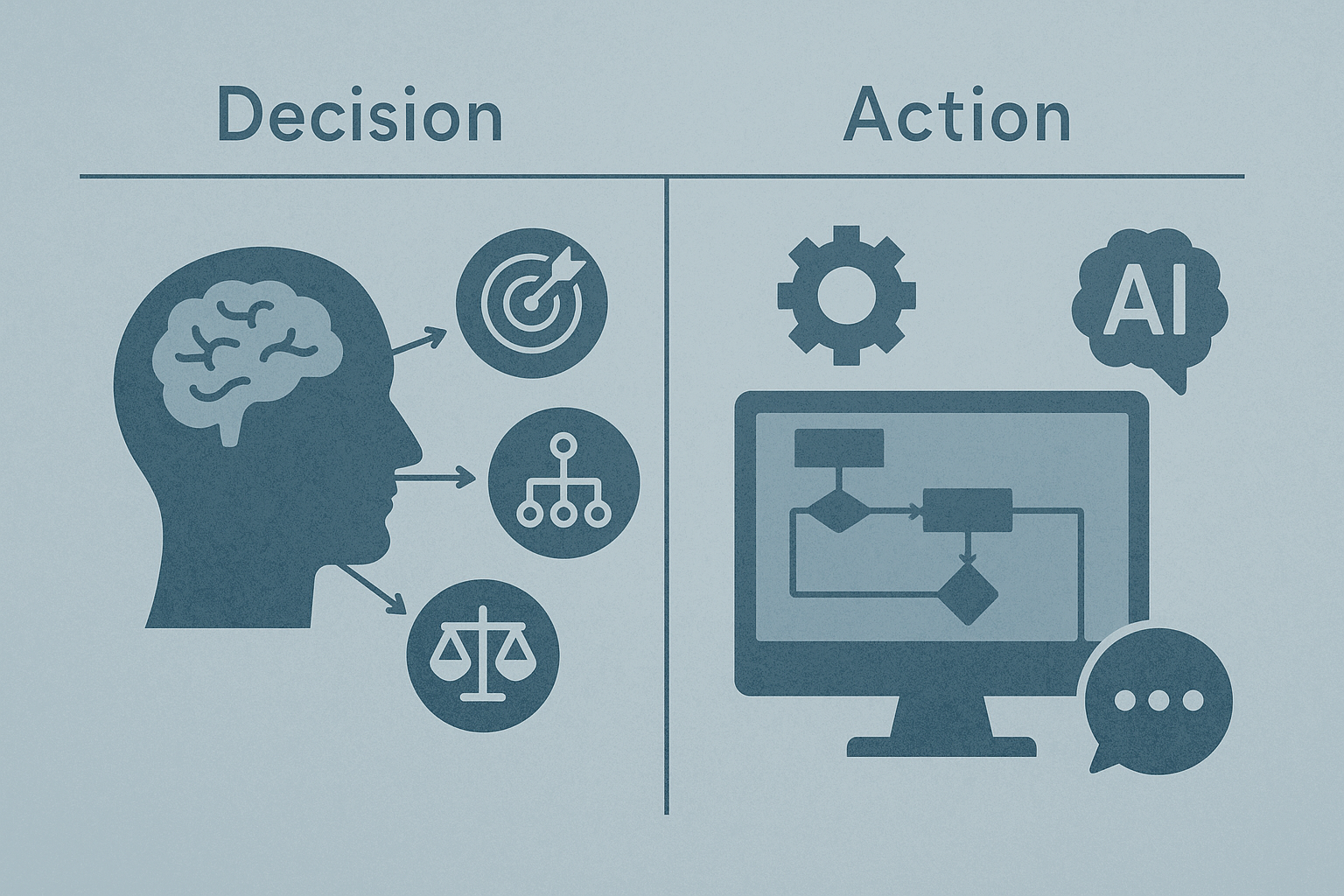
In my earlier essay, The Anatomy of AI Work, I described this distinction in another context. AI is becoming increasingly capable at action-level tasks — optimizing, executing, refining. But decision-level tasks — like framing, interpreting, and generalizing — remain elusive.

Mathematics makes this distinction stark. You can automate the proof of a lemma. But identifying the right lemma? That’s something else.

The most profound steps in mathematics are rarely just answers. They’re questions that reorganize understanding.

That’s why judgment is not a luxury. It’s the heart of discovery. And until AI learns not just how to walk the path, but how to invent the trail, it will remain on the outside — imitating thought, but not engaging in it.

This isn’t just a limitation of AI. It’s a risk for us. In a recent essay, AI and the Erosion of Knowing, I explored how over-reliance on tools that execute well can slowly atrophy our ability to ask, judge, and imagine. If we outsource not just the steps, but the framing of the question, we may lose the very skill that makes mathematics — and knowledge itself — creative.

What’s at stake isn’t just what AI can do. It’s what we stop doing, once it can.


Why Gödel Still Matters

Gödel’s incompleteness theorems didn’t just shatter the dream of a complete formal system. They redefined what it means to know.

His proof used only finite tools—arithmetic, syntax, and symbolic encoding. Yet what it uncovered was infinite: in any sufficiently rich formal system, there are true statements that can never be proven within it.

The problem isn’t the tools. It’s the boundaries.

Some truths don’t resist proof because they’re too complex. They resist because the system can’t even see the need to ask.

And that insight cuts to the heart of the AI debate.

Large models manipulate symbols, match patterns, optimize objectives—but they don’t ask: Is this system enough?

Mathematicians do. We construct new frameworks, challenge assumptions, and pose questions that stretch the boundaries of what we thought was expressible.

But—and this is crucial—even mathematicians can’t answer every question. That’s what Gödel showed. There are truths we feel are true but cannot yet prove. Questions that point to real structure but remain unresolved.

The difference is: we know we don’t know.

We navigate with intuition, taste, and judgment. We recognize when something matters—even if it escapes our grasp. That awareness, that sense of what’s missing, is not mechanical. It’s a distinctly human kind of seeing.

AI doesn’t have that. Not yet.

To step outside a system isn’t just to outgrow it. It’s to realize there is always something beyond.

That’s the leap Gödel made. That’s the mystery Ramanujan lived with. And that’s the frontier AI has not crossed.


From Real Numbers to New Realities

If AI someday learns to reason, it won’t be because it solves a hard problem. It’ll be because it learns to see differently — to reframe what counts as a problem in the first place.

That’s what human mathematicians have done for centuries. The greatest shifts in mathematical thought didn’t come from executing harder calculations. They came from changing the lens entirely:

  • From Real to Complex Numbers: For centuries, √−1 was considered meaningless. But extending the number line into the complex plane didn’t just “solve equations” — it revealed symmetries, connected algebra and geometry, and gave rise to modern physics.
  • From Euclidean to Riemannian Geometry: Euclid’s fifth postulate governed geometry for two millennia — until mathematicians asked, What if it doesn’t hold? Riemann’s answer didn’t just alter geometry. It laid the foundation for Einstein’s general relativity.
  • Cantor and the Infinities: It wasn’t obvious that some infinities are “larger” than others. Cantor’s diagonalization shattered the intuition that infinity was monolithic. In doing so, he built the modern theory of sets — and faced deep resistance from his peers, who found the idea too radical.
  • Turing and the Machine: Alan Turing didn’t prove a theorem. He invented a new kind of question: What does it mean for something to be computable? The Turing machine wasn’t just a model of calculation — it was a model of limits.
  • Grothendieck’s Revolution: In the 20th century, Alexandre Grothendieck reimagined algebraic geometry by inventing new abstract structures — sheaves, schemes, and topoi. These weren’t tools to solve old problems faster. They reformulated what the problems were.

These shifts weren’t about finding answers. They were about redefining the space of what could be asked.

That’s not execution. That’s invention.

And until AI can make those kinds of moves — not just follow rules, but reinvent the terrain — it won’t do mathematics the way humans do.

It may answer questions. But it won’t ask the ones that matter.

Mathematical mastery of infinity often means knowing when to tame it — not to reach endlessly, but to choose where to stop.


Taming Infinity: A Human Art

Of course, mathematicians don’t just dream. They also tame.

Infinity isn’t just a symbol of the unknowable. It’s a landscape we’ve learned to navigate — not by eliminating it, but by shaping its contours.

Modern mathematics is filled with tools that bring the infinite within reach. Here are just a few:

  • Compactness Theorem: Shows that infinite consistency can be captured by finite fragments — a cornerstone of model theory.
  • Cantor’s Diagonal Argument: Reveals the uncountable through a simple, finite maneuver — a blueprint for thinking beyond the enumerable, and the conceptual seed behind Gödel’s incompleteness and Turing’s halting problem.
  • Noetherian Induction: Tames infinite descent in algebra and geometry — a finiteness principle that undergirds modern theories like Grothendieck’s schemes.
  • Ramsey Theory: Shows that in any sufficiently large structure, pattern is not optional but inevitable — a principle that echoes through logic, combinatorics, and theoretical computer science.
  • Fermat’s Last Theorem (Wiles): A question about integers — deceptively simple — was resolved only by building a vast web of modern number theory: elliptic curves, modular forms, and infinite Galois representations. The infinite wasn’t sidestepped. It was harnessed.
  • Poincaré Conjecture (Perelman): A century-old question about the shape of three-dimensional space was settled through Ricci flow — a geometric evolution equation that smooths out infinite curvature and complexity over time. Perelman’s proof traversed the infinite, but delivered a finite, complete insight.

These aren’t just mathematical tricks. They are acts of vision — showing how infinite complexity can be transformed into finite understanding.

The point isn’t that infinity disappears. It’s that we’ve learned to fold it, reshape it, and hold it — without letting it slip through our hands.


The Real Bottleneck

The challenge isn’t just scale. Or compute. Or optimization.

It’s the ability to ask: What needs to be discovered here?

The deepest insights in mathematics rarely come from wandering further into infinity. They come from knowing when — and how — to stop. To name a structure. To frame a question. To trace a pattern through chaos and say: Here. This matters.

That move isn’t algorithmic. It isn’t forced. It’s not a brute-force search. It’s a leap.

A leap Ramanujan made again and again — not because he had proof, but because he saw something worth proving.

Hardy once said that Ramanujan’s theorems “must be true, because if they were not true, no one would have had the imagination to invent them.”
Their collaboration was full of tension — Hardy insisted on proof; Ramanujan followed intuition. But over time, even Hardy admitted: “I had to trust his insight.”

Another time, when Ramanujan was ill in bed, Hardy visited and mentioned that his taxi’s number — 1729 — seemed dull. Ramanujan immediately replied: “No, it is a very interesting number; it is the smallest number expressible as the sum of two cubes in two different ways.”

That’s not computation. That’s not search.
That’s intuition on fire.[2]

AI can derive formulas. It can test variations.
But it doesn’t see the spark.
It doesn’t get excited. It doesn’t get suspicious.
It doesn’t chase an idea that isn’t yet real.

Until machines can do that, they’ll compute.
But they won’t wonder.[3]

That’s the real bottleneck.

The ability to reach toward the infinite — and know when to stop.


Notes

1. LLMs have made notable advances in solving formal math problems, including competition-level questions. The gap I refer to here is not in computation, but in the capacity to reframe problems or sense structural shifts without explicit guidance.

2. Ramanujan often described his insights in mystical terms, but the point is not to assert supernatural explanation, rather to emphasize how far intuition can leap ahead of proof.

3. It’s possible that AI may eventually emulate or approximate intuition-like leaps through architectures we don’t yet fully grasp. But as of now, such shifts seem to arise from mechanisms outside the current paradigm.

Originally published in this Substack post.
AI and the Erosion of Knowing

“The obstacle was always the path.” Adapted from a Zen proverb

In the Renaissance, apprentices learned to paint by grinding pigments, mixing oils, stretching canvas, and copying masterworks line by line. In architecture, students spent years sketching by hand before they touched a computer. In math, the best way to understand a theorem is to try to prove it yourself—and fail.

Today, that slow accumulation of competence is being replaced by a faster rhythm.

Ask an AI to write a proof, generate a building, produce an image, or answer a math question—and it will. But something essential gets skipped. And what gets skipped doesn’t just disappear. It quietly erodes.

AI gives us output without process. The result: polished answers with no foundation.

The Eroding Scaffold

Learning isn’t just about information. It’s about structure and the path you took to get there. You don’t truly understand a concept until you’ve built the scaffold it rests on—step by step, skill by skill.

Mira’s Derivative

Take Mira, a student learning calculus. She’s supposed to learn how to compute derivatives. The teacher explains the chain rule: when one function is nested inside another, you must differentiate both, in the right order. It’s abstract, so Mira does what students do—she turns to an AI tutor.

She types:

“Find the derivative of sin(x² + 3x).”

The AI answers instantly:

cos(x² + 3x) · (2x + 3)

It even offers a short explanation. Mira copies it down and moves on.

What she didn’t do:

– Simplify the inner expression.

– Apply the rule mechanically.

– Make a mistake and figure it out.

– Internalize the rhythm of composition and change.

Now fast-forward two months. Mira sees a problem she’s never encountered:

“Differentiate xᵡ.”

She freezes. No familiar template. No AI available. No internal scaffold to fall back on.

She reached the destination — but never built the path.

The skipped struggle was what encoded the concept.

Leo’s Essay

Now consider Leo, a college student writing an essay on political philosophy. He’s supposed to take a position on Hobbes’s Leviathan and argue whether absolute sovereignty is justified today.

Traditionally, Leo would:

– Clarify Hobbes’s argument,

– Develop a counterposition,

– Find textual evidence,

– Draft and revise a logical structure.

Instead, he types:

“Write a 5-paragraph essay arguing against Hobbes’ justification of sovereign power.”

The AI delivers—fluent, plausible, even citing sources. Leo pastes it in, tweaks a few lines, and submits.

A week later, he’s asked:

“How would Hobbes respond to modern surveillance capitalism?”

He flounders. The structure was never his. The reasoning was never practiced. The scaffolding was never built.

He didn’t outsource writing. He outsourced thinking.

Teachers aren’t grading the prose. They’re grading the reasoning it reveals.

Art Without Sketching, Architecture Without Lines

In design and architecture, we’re seeing the same thing. AI can generate facades, floor plans, and renders in minutes. But without grounding in scale, structure, or constraint, designs become fragile—beautiful but unbuildable. The result is a facade that ignores sun direction, a floor plan that fails fire code, and a portrait with six fingers.

In art, tools like Midjourney let users create stunning illustrations from a few words. But if you can’t draw, can you see? Can you revise? Can you critique? Can you tell what’s off?

Drawing is not just a means of production—it’s a way of learning to notice. Line by line, it teaches scale, proportion, balance, rhythm. Without that training, feedback becomes guesswork. Revision becomes roulette.

When the tool does the shaping, the human stops developing the eye.

And when the AI makes a mistake—one that’s subtle, structural, or compositional—there’s no foundation to catch it. You don’t just lose the sketch. You lose the ability to tell when something is wrong.

Oversight Collapse

AI doesn’t reason — it samples.

When a model like GPT writes a paragraph or answers a question, it isn’t deriving a conclusion from first principles. It’s drawing from a probability distribution — choosing what sounds most plausible based on past data.

The result? Output that feels fluent — but isn’t guaranteed to be correct.

That’s what makes AI mistakes dangerous. They’re not just wrong. They’re plausibly wrong — errors with the gloss of insight. And if we’ve skipped the scaffolding, we can’t tell the difference between coherence and truth.

This is the tipping point: when we’re still “in the loop,” but can no longer verify what we see. We’ve become fluent — but not competent. You look like you’re in control. But you’re just along for the ride.

And the risk isn’t limited to math or logic. In “wicked” domains — ethics, design, law, writing — there may be no single right answer. What matters is the ability to justify, adapt, revise, and notice what doesn’t quite fit.

That capacity comes from friction — from having built the internal scaffold of reasoning.

AI gives us output. But it skips the reasoning. It removes the friction — and with it, the growth.

From Work to Erosion

In a recent post, I argued that AI is reshaping work not by replacing entire jobs, but by separating judgment/decision from execution/action. Tools like GPT, Copilot, and dashboards take over action-level tasks. But what remains human is the ability to frame problems, make judgments, and verify outcomes.

In that example, Ada, a software engineer, wasn’t made obsolete. Her job changed. Execution was automated. Judgment was not.

But here’s the deeper risk: what if using AI to execute also erodes our ability to decide?

That’s the dynamic explored here. When AI lets us skip foundational steps—whether in calculus, writing, or design—it removes the very scaffolding that enables judgment to form.

At first, it feels like acceleration. But over time, it becomes erosion.

The erosion of action-level skill becomes the erosion of decision-level agency.

What Can Be Done

The goal isn’t to abandon AI. It’s to use it without losing ourselves.

That means:

– Choosing tools that show their work, not just their output.

– Practicing skills we no longer “need,” because they still underpin everything else.

– Teaching not just what to do, but how to decide, how to verify, and how to notice what’s missing.

What’s at stake isn’t just productivity. It’s agency.

Final Thought: The Skills We Skip Are Still Ours to Build

When we let AI do the scaffolding for us, we don’t just skip steps—we weaken the very structures that make thinking, reasoning, and creating possible.

The skills we skip don’t vanish. They decay. Quietly. Until we need them—and find we’ve forgotten how they worked.

So yes, use AI. But build the scaffold anyway.
Because the point isn’t just getting it right — it’s still knowing what right looks like.

That’s the kind of knowing worth protecting.

Originally published in this Substack post.
The Harari Fallacy: AI Isn’t Alien—It’s a Meta-Institution

In Nexus, Yuval Noah Harari frames AI as a historical rupture—a leap from human-directed information systems to what he calls an “alien intelligence” that is “capable of making decisions and generating ideas by itself.” He describes this shift as “a completely new kind of information network… controlled by the decisions and goals of an alien intelligence.” In doing so, Harari casts AI as an autonomous agent—one with independent goals and the power to shape society. He warns that such systems may sever humans from the center of epistemic and political power.

This framing—what we might call the Harari Fallacy—is compelling, but in a crucial way, misleading. Harari rightly captures the scale of transformation. But by casting AI as external, he obscures its recursive and embedded influence. AI is not a foreign agent; it is a system born from within our institutions. A shift more intimate, and arguably more dangerous.

AI isn’t just part of the institutional fabric. It is becoming the logic that designs the fabric itself.

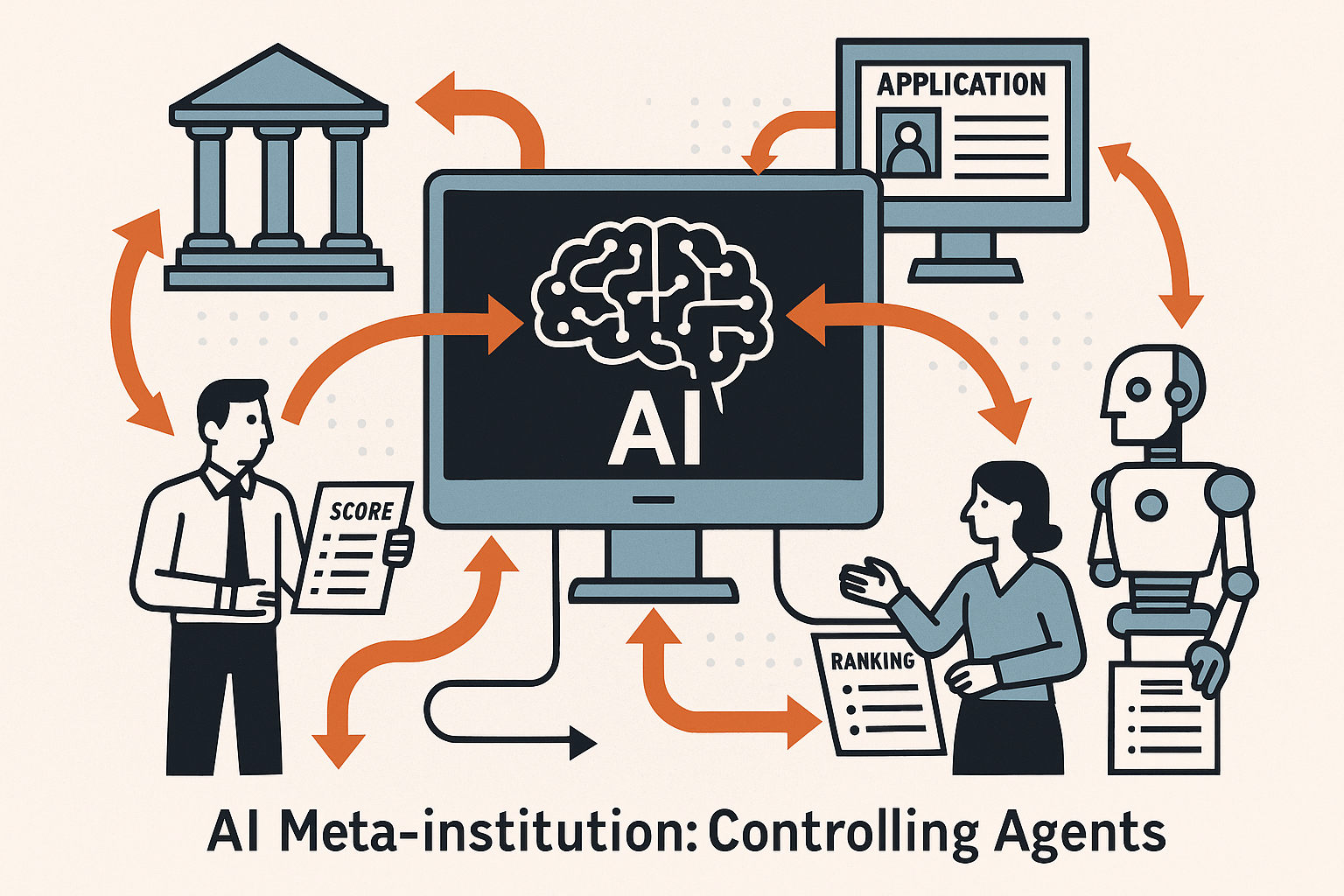
AI today is not merely a tool. Not merely an agent. Nor just an institution in the bureaucratic sense. It has become a meta-institution: a designer and controller of other agents—human and organizational. It configures evaluators, retrains bureaucrats, rewrites rules, and subtly reshapes how judgment is encoded across domains. It doesn’t just automate decisions. It restructures who gets to decide and how.

This essay builds on Harari’s provocation but reframes AI not as an independent actor, but as a meta-institution embedded in our institutional fabric. In doing so, AI is not just automating decisions—it is reshaping the sociotechnical regime: the interlocking system of technologies, norms, routines, and power relations that govern institutional behavior.

This argument draws from a broader intellectual tradition—Bruno Latour, James C. Scott, and Shoshana Zuboff among them—who show how power often hides in process, not in persons. While this essay focuses on how those dynamics play out in practice, a future post will unpack how their theories help illuminate the architecture of AI’s influence.

We will follow a fictional example—InnovaCorp, a mid-sized tech firm adopting an AI hiring platform—to illustrate how these dynamics unfold.

From Alien Intelligence to Recursive Infrastructure

AI is not just an agent. It’s the author of agents’ scripts.

Harari characterizes AI as an autonomous decision-maker—an agent. But agents operate in environments. What AI increasingly does is create the environment that other agents operate in.

At InnovaCorp, HR initially adopts AI to streamline hiring. It assigns candidate scores based on historical “success” data. But soon, hiring managers began to rewrite job descriptions to better attract high-scoring candidates. Over time, the algorithm isn’t just filtering candidates—it’s shaping the definition of what the company thinks a good candidate is.

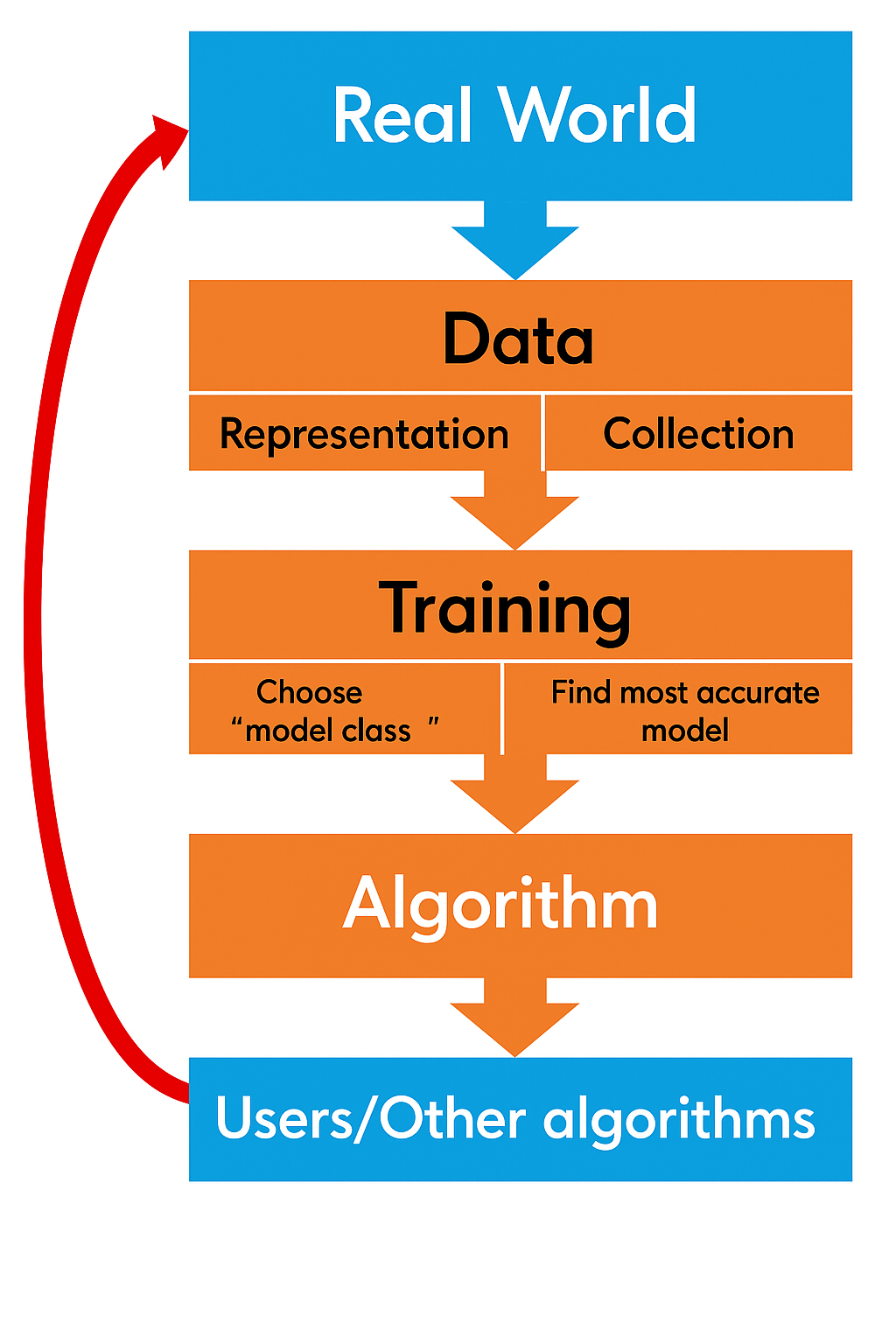
This is recursive infrastructure: institutions reacting to outputs that they helped produce, now restructured by machine logic.

Redesign, Not Just Drift

AI does not just decide outcomes. It decides what counts as a decision.

At InnovaCorp, optimization gradually becomes governance. Hiring managers begin selecting candidates not on qualitative impressions, but based on AI-generated scores. The metric becomes the mission.

This shift changes not only who is hired but also how jobs are defined, how performance is evaluated, and how internal accountability is structured. Candidates start optimizing their resumes for the algorithm—stuffing them with the right keywords, formatting them for machine parsing, shaping their experience to match historical patterns. The AI system, designed to reflect institutional values, begins to redefine them.

This is not a case of automation drifting into misuse. It is an active reprogramming of institutional logic. The AI, while seemingly neutral, becomes the architect of institutional priorities.

And this is not confined to fiction. At Amazon, an AI recruiting tool learned to penalize resumes containing the word “women’s,” effectively institutionalizing gender bias based on past data. At HireVue, video-based assessments claimed to score “communication” and “learning ability” by analyzing facial expressions and voice tone—until public scrutiny forced the company to remove facial analysis from the system. And in the class-action lawsuit Mobley v. Workday, plaintiffs allege that Workday’s AI system systematically discriminated against older candidates, potentially affecting millions. These examples show how AI tools can silently reshape what institutions prioritize, until challenged by public or legal intervention.

Governance Failure at the Meta-Level

The danger isn’t that AI becomes intelligent. It’s that institutions stop needing to be.

Consider a candidate rejected by the system. She had a strong but unconventional background—community organizing, international work, and a nonlinear career path. But she lacked the calibrated indicators the model preferred. When she inquires, no one at InnovaCorp can explain the decision. It is buried in a stack of features, weights, and patterns. There is no appeal. No clarity. No deliberation.

This is a governance failure not just of an algorithm, but of the institution that outsourced its judgment. Where once institutions justified decisions, they now defer to scores. The ritual of reasoned explanation—central to legitimacy in public and private decision-making—disappears. What remains is an output.

This transformation isn’t hypothetical—it’s already under regulatory scrutiny.

What Is To Be Done: Designing for Meta-Governance

To govern AI, we must govern how AI governs us.

We can no longer think of algorithmic oversight as a matter of model accuracy alone. We must consider how institutions structure themselves around AI—and what it would take to ensure that those structures remain legible, contestable, and aligned with human values.

This means building systems that support contestation: not just accepting or rejecting decisions, but interrogating them. Imagine if every automated hiring decision were accompanied by a counterfactual: “Your score was 85. Had you listed ‘Project Leadership’ under ‘Cross-Functional Initiatives,’ your score would have been 95.” This reframes opacity as a design choice, not a necessity.

It also means preserving legibility: institutions should disclose what their AI systems are optimizing for, what data they are trained on, and what known biases they carry. A hiring algorithm might come with a visible tag: “Optimized for: Speed-to-Hire. Trained on: 2018–2022 employee data. Known exclusions: nontraditional career paths.” That alone would shift how we perceive and engage with algorithmic outputs.

And finally, we must reinforce institutional agency: decisions made by AI should be overrideable by humans with structured justification. This keeps humans in the loop, not as mere validators, but as agents capable of moral and contextual judgment. If AI makes governance efficient, it must not make it unaccountable.

These are not just aspirational ideas—they are design principles, and increasingly, they are becoming formalizable. In 2024, the EU’s AI Act formally classified AI systems used in employment, education, and credit as “high-risk,” mandating transparency, data quality, human oversight, and documented accountability. In New York City, Local Law 144 now requires annual bias audits for automated hiring tools, with public disclosure and candidate notification. And in the U.S., the White House’s Blueprint for an AI Bill of Rights urges protections against algorithmic discrimination and pushes federal agencies to enforce civil rights standards even when decisions are made by machines. In my own research on algorithmic fairness, feedback, and strategic behavior, I explore how institutions can navigate these trade-offs in noisy, biased environments. But the key is to treat AI not merely as a system, but as a governance substrate—a meta-institution whose influence must itself be governed.

The Broader Point

The question is no longer whether AI governs. It’s how well it does it—and for whom.

AI systems are already performing core institutional functions: filtering applicants, shaping curricula, allocating credit, and moderating speech. They are evaluators, gatekeepers, and norm-setters. But they do so without transparency, without recourse, and often without awareness of their own normative consequences.

We are not governed by alien minds. We are governed by recursive procedures—by optimization routines and feedback loops that encode incentives we do not always see.

From resume filters that punished women’s chess captains to video interviews that claim to quantify your “communication ability” from facial tics, the story of AI’s rise isn’t one of intelligence alone—it’s one of silent institutional redesign.

We are not just delegating decisions—we are delegating the power to define what a decision is.

The real question, then, is not whether AI should have institutional power. It already does. The question is: what kind of meta-institution are we allowing it to become—and who gets to decide?

Sources and Further Reading

  • Yuval Noah Harari, Nexus: A Brief History of Information Networks from the Stone Age to AI (2024)
  • James C. Scott, Seeing Like a State: How Certain Schemes to Improve the Human Condition Have Failed (1998)
  • Shoshana Zuboff, The Age of Surveillance Capitalism: The Fight for a Human Future at the New Frontier of Power (2019)
  • Bruno Latour, Science in Action: How to Follow Scientists and Engineers Through Society (1987) and Pandora’s Hope (1999)
  • Amazon’s resume screening AI: Jeffrey Dastin, “Amazon Scraps Secret AI Recruiting Tool That Showed Bias Against Women,” Reuters, Oct 2018. Link
  • HireVue facial analysis: Drew Harwell, “A Face-Scanning Algorithm Increasingly Decides Whether You Deserve the Job,” Washington Post, Oct 2019. Link
  • Workday lawsuit: Link
  • NYC Local Law 144 (2023): Full text
  • EU AI Act (2024): Summary
  • Blueprint for an AI Bill of Rights (2022): White House OSTP

For more of my work, visit my academic website.

The Anatomy of Work in the Age of AI

Not whether AI will change work, but what kind of work — and which workers — will endure.

Former President Obama recently shared an interview with Dario Amodei, CEO of Anthropic, who warned in Axios that AI could eliminate up to 50% of entry-level white-collar jobs within five years, potentially raising unemployment to 10–20%. Economists and institutions like the IMF and the World Economic Forum are sounding similar alarms.

This kind of forecast is no longer hypothetical. It reframes the urgency of our conversation: not whether AI will change work, but what kind of work — and which workers — will endure.

In this post, I want to offer a clearer way to think about that question. Drawing on recent research with colleagues, I propose a framework that breaks down jobs into their smallest units — skills — and then divides each skill into two distinct components: decision-making and execution. This distinction, I argue, is essential to understanding where humans still matter, how AI is reshaping labor, and what we should be measuring, teaching, and building toward.

If we can’t say what a job is, we can’t reason about what AI is replacing.

The Wrong Debate

Much of the public debate still hinges on a narrow question: Will AI replace us, or will it help us? But this framing misses the deeper structural shift underway. It treats jobs as flat, undifferentiated collections of tasks, as if replacing a few steps is equivalent to automating the whole. In reality, most jobs are complex systems of judgment, adaptation, and execution. And not all parts of that system are equally exposed to AI. If we want to understand how work is changing — and what skills will remain valuable — we need a more granular lens.

Ada’s Shift

Consider Ada, a mid-level software engineer. Just a few years ago, her day revolved around writing code, debugging features, documenting functions, and reviewing pull requests. Today, GitHub Copilot writes much of the scaffolding. GPT drafts her documentation. Internal models flag bugs before she sees them. Her technical execution has been accelerated — even outsourced — by AI. But her job hasn’t disappeared. It has shifted.

What Ada does has changed. What Ada is responsible for has not.

What matters now is whether Ada can decide what to build, why it matters, how to navigate tradeoffs that aren’t in the training data — and crucially, whether the result is even correct. Her value no longer lies in execution — it lies in judgment and verification. This isn’t just a shift in what she does — it’s a shift in what makes her valuable. Execution can be delegated. Judgment cannot.

The Real Divide

Ada’s story isn’t just a sign of change—it’s a window into the deeper structure of modern work. In our research, we argue that to understand how AI is reshaping labor, we need to go beyond jobs and tasks, and examine the composition of skills themselves

Every skill, we propose, has two layers:

  • Decision-level skills: choosing goals, framing problems, evaluating tradeoffs
  • Action-level skills: executing plans through tools, language, or procedures

This distinction is foundational to our framework. It allows us to model worker capabilities and job demands more precisely. And once you see the split, it’s everywhere.

  • A doctor uses AI to flag anomalies in a scan — but must decide when to intervene, and why.
  • An analyst uses GPT to draft a report — but must decide which story the data tells.
  • A teacher uses AI to generate exercises — but must decide how to adapt them for a struggling student.
  • A programmer uses Copilot to write code — but must decide what to build, how to build it, and in what language, architecture, or paradigm.

AI acts. Humans decide. That’s the frontier.

This isn’t a cosmetic difference. It’s a deep structural boundary — one that shapes who adds value, who adapts, and who gets displaced.

The distinction between decision and action is becoming the new fault line in labor.

A New Lens on Success

This structure isn’t just descriptive—it makes success measurable. We model each worker using an ability profile that captures their expected strength and variability at each subskill. Given a job’s subskill demands, we can compute the probability of success—a quantitative match between a worker’s capabilities and a job’s needs. This also lets us explore how training, support, or AI tools can shift that success rate—and identify where small changes make a big difference.

One of our key findings is that decision-level skills often act as a bottleneck: small improvements can trigger phase transitions, where success probability jumps sharply rather than smoothly. A little more judgment can be worth far more than a lot more action.

We also show how merging two workers—or pairing a worker with an AI system—can significantly boost job success by combining complementary skills. This framework yields four canonical pairings—each capturing a mode of human or hybrid productivity:

  1. Strong decision + strong action: the ideal worker, high success probability.
  2. Strong decision + weak action: can be aided by AI to improve execution.
  3. Weak decision + strong action: needs human or institutional support to frame and evaluate problems.
  4. Weak decision + weak action: unlikely to succeed without extensive support or retraining.

This pairing framework also models human-AI collaboration. AI tools excel in action-level tasks, reducing execution noise. But they cannot compensate for poor decisions. Conversely, humans with decision strength but noisy action skills can leverage AI to execute more reliably.

AI can make your actions sharper. But it takes another human—or a better-trained self—to make your decisions wiser.

Rethinking Upskilling

Most upskilling initiatives focus on teaching people how to use tools — how to code in Python, use Excel, write better prompts. But these are action-level skills. They train people to do — not to decide. And as AI becomes more fluent in these domains, such training risks becoming obsolete even faster.

What our model shows is that the most durable leverage comes from strengthening decision-level abilities: learning how to formulate the right problem, evaluate competing goals, and adapt strategy under uncertainty. These skills are harder to teach, harder to measure — but they’re also harder to replace.

Reskilling should not mean trading one automatable task for another. It should mean elevating workers into roles where human judgment is indispensable — and building the scaffolding to support that transition.

The goal isn’t to out-code AI. It’s to out-decide it.

But understanding skill composition isn’t just useful for support or upskilling—it changes how we identify and select talent in the first place.

Beyond the Average: Hiring for Complements, Not Proxies

Traditional hiring often relies on blunt proxies—credentials, test scores, résumé keywords—that collapse a person’s skill into a single metric. But real talent is rarely uniform. Someone may struggle with polish but excel at solving hard problems. Another may be smooth in execution but shallow in judgment. Conventional systems force institutions to average across these traits—hiring for perceived overall competence rather than true fit.

Our framework breaks that bind. By distinguishing decision-level and action-level abilities, and modeling how they combine, we can identify complementary strengths—either across people or in partnership with AI. This makes it possible to spot a high-judgment candidate with messy execution and pair them with tools that stabilize output. Or to recognize an efficient executor who thrives when decisions are pre-structured by a manager or teammate.

You no longer have to bet on the average. You can hire for the right complement.

This shift doesn’t just improve hiring. It makes evaluation more precise, support more targeted, and teams more balanced. It also disrupts the performative incentives of current systems, where polish often trumps insight, and fluency overshadows depth. If we can build systems that recognize decision strength—even in the absence of perfect execution—we can unlock talent that today gets overlooked.

Designing for the Future of Work

Ada’s story is only the beginning. Her challenge—learning how to decide, not just how to do—is quickly becoming the central challenge for institutions.

The AI wave isn’t just increasing efficiency. It’s reshaping the anatomy of work, separating action from decision, and forcing us to ask: what remains uniquely human?

Economist Daron Acemoglu argues that the most dangerous trend in recent technological history isn’t automation itself—it’s the way we’ve used automation to displace workers rather than augment them. Over the past few decades, many technologies have replaced mid-skill jobs without meaningfully improving productivity. The result: wage stagnation, rising inequality, and a polarized labor market. Acemoglu’s call is clear—we need to redirect innovation toward task-augmenting technologies that enhance human capability rather than erode it.

Our framework offers a concrete way to act on that vision. By distinguishing between decision- and action-level skills, and modeling how they interact with AI, we can design technologies—and institutions—that truly support human strengths.

But the real challenge is not theoretical. It’s institutional.

If we continue to train, hire, and evaluate people based on action-level outputs, we will misread talent, mistrain workers, and misdesign systems. Worse, we will cede the future of work to automation by default—not because AI is more capable, but because we forgot how to measure what humans uniquely contribute.

Our model not only reframes how we think about work, but also offers a practical tool for institutions. By enabling fine-grained evaluations along decision- and action-level dimensions, it allows for more accurate assessments—not just in hiring, but also in upskilling, promotions, task allocation, and even layoff decisions. Instead of collapsing a worker’s abilities into a single metric, we can now ask: where does their judgment shine? Where is support or augmentation most effective?

We need tools, metrics, and institutions that can recognize decision-level excellence—not just output volume. Otherwise, we’ll keep mistaking speed for insight, and productivity for progress. That means rethinking how we evaluate students, support workers, and guide innovation. It means building systems that value judgment, verification, ethical reasoning, and strategic adaptation—the things that don’t show up in a prompt but define good decisions.

The question is no longer whether humans have a role. The question is whether we’re designing for it.

This is the work ahead. And we’ll need to be as thoughtful about decisions as we’ve been clever with tools.


This essay draws on a forthcoming paper, A Mathematical Framework for AI-Human Integration in Work, by L. Elisa Celis, Lingxiao Huang, and Nisheeth K. Vishnoi, to appear at ICML 2025. You can read the full paper here: https://arxiv.org/abs/2505.23432

Can AI Allocate Better Than Traditional Institutions?

Efficiency, Fairness, and Redress in the Age of AI Models

A reader asked a deceptively simple question: If AI systems are becoming institutions, can they actually do better than the ones they’re replacing?

But before we go deeper into performance or fairness, we should ask something more basic: why are we turning to AI in the first place? The answer, more often than not, is convenience.

AI systems promise to reduce administrative burdens, scale evaluations, and produce consistent outputs. They help organizations avoid the messiness of subjective judgment, slow deliberation, and case-by-case exception-making. In short, they are attractive precisely because they make allocation easier—not necessarily better.

And this convenience comes with a cost. The smoother the system, the harder it becomes to question its workings. When processes feel seamless, we stop noticing them—and stop questioning their logic.

For instance, Hilke Schellmann, in her book The Algorithm, documents how companies increasingly adopt AI hiring tools that screen applicants based on facial expressions, vocal tone, or inferred personality traits. One hiring manager put it plainly: “The system just gives us a score. We don’t really know what it’s based on, but it’s fast.”

Convenience here isn’t just a motive—it becomes a justification.

And that should worry us. Because at the heart of institutional power lies a fundamental challenge: the allocation of scarce resources. Who gets access to opportunity, support, attention, or trust? And how do we justify those decisions?

In the age of AI, this question surfaces along three dimensions: efficiency, fairness, and redress.


Efficiency: What Are We Optimizing For?

AI systems promise efficiency. They operate at scale, minimize friction, and outperform humans on many narrow tasks. But allocation in human systems is rarely narrow.

Efficiency only matters after we’ve decided what counts as success—and that’s not a technical choice, but a values-driven one.

  • In hiring: Are we optimizing for long-term retention? Short-term output? Cultural fit?
  • In education: Should we prioritize academic scores, future income, or equitable access?
  • In healthcare: Do we focus on recovery odds, or treat the most vulnerable first?

AI systems demand that these values be made precise—often mathematically. But in practice, goals are fuzzy, contested, and contextual.

In a forthcoming work on human–AI collaboration in job–worker matching, we show how even small shifts in a model’s objective—such as prioritizing average success probability versus robustness—can yield very different worker selections. What appears efficient under one criterion often privileges a particular performance profile, even when other candidates would succeed under uncertainty.

Efficiency, then, is not neutral. It is an encoding of what we choose to value.


Fairness: Comparing Biases

Even without explicit prejudice, decision systems can reflect and amplify structural inequities.

In some of my recent work, we examined how seemingly objective evaluations—when combined with limited information and institutional risk aversion—can systematically disadvantage certain groups. Not because of individual intent, but because of how noise, uncertainty, and caution interact at scale.

One insight is that institutions often set conservative thresholds to avoid mistakes. But when those thresholds are applied to noisier signals—say, from candidates with less conventional backgrounds—they lead to higher exclusion rates. The system penalizes variance, even when it contains a valuable signal.

These dynamics resemble well-known behavioral patterns. When people (or institutions) are unsure, they often choose what feels safest. But “safe” choices often align with familiar profiles—and familiarity isn’t the same as fairness.

This raises a crucial point: fairness isn’t a property of a model alone. It’s a function of the model, the environment it operates in, and the institutional choices around it.

  • If a human decision-maker is biased, that bias might be inconsistent, unconscious, or improvisational.
  • If an algorithm is biased, its behavior can (at least in theory) be audited, documented, and corrected.

That’s a potential advantage—if we build the infrastructure to make those corrections possible. Transparency, oversight, and public reasoning are essential. Without them, systematic bias becomes invisible and unchallengeable.


Redress: Who Do You Appeal To?

Institutions, when they work well, offer recourse. There are processes for appeals, complaints, or explanations. But even in traditional systems, these mechanisms are often limited or inaccessible.

  • How many job applicants have meaningfully appealed a rejection?
  • How many students have overturned an admissions decision?
  • How many people denied a loan had the tools to contest it?

AI doesn’t necessarily make redress worse. But it can make the absence of redress harder to see.

When people are told “the algorithm decided,” it can feel like the end of the conversation. There’s no name, no rationale, no one to reason with. Even those deploying the model might not fully understand its logic.

That’s not just a technical problem. It’s a civic one.

If individuals can’t understand or contest the systems that judge them, the result is often disillusionment or disengagement. In ongoing research, I’ve been exploring how people adjust their effort when outcomes feel opaque or unresponsive. When effort seems decoupled from reward, people respond accordingly. What looks like underperformance may simply be rational withdrawal from an illegible game.

And when these behaviors get fed back into training data or performance metrics, the system can end up learning that certain groups are less “engaged” or “qualified”—not because they are, but because they were excluded to begin with. Thus begins a loop of misinterpretation and misallocation.


Toward Institutional-Grade AI

If AI systems are going to play institutional roles, they need to meet institutional standards:

  • Clear articulation of goals and tradeoffs.
  • Ongoing monitoring of impact across groups.
  • Transparent processes and avenues for appeal.

We’ve made it easy to scale decisions. But legitimacy is harder. And in matters of justice, it’s not the speed of a decision that matters—it’s whether anyone can speak back to it.


Further Reading

If you’re curious about the ideas in this post—job-worker matching, emergence of institutional bias, feedback loops, and fairness in algorithmic systems—I’ve written about them more formally elsewhere. Feel free to reach out if you’d like pointers or want to discuss further.

AI Are the New Institutions

How algorithms gained decision-making power—and what they replaced

In my previous post, I argued that AI systems—particularly those built on large models—are no longer just tools. They are becoming institutions.

Not in the legal sense. But in function.

They structure judgment, allocate opportunity, and shape legitimacy, just as courts, schools, or hiring boards once did.

This post explains what that claim means in practice. Not through abstraction, but through concrete, recent events.

When I say “AI,” I don’t mean a single system. I mean a distributed set of deployed models—language models, scoring tools, surveillance networks—that now act with institutional authority in many parts of life.


What makes something an institution?

Institutions are not just buildings or bureaucracies. They are systems of trust and authority.

They determine:

  • Who gets hired.
  • Who is heard.
  • Who is protected or punished.
  • And who gets left out.

They operate over time. They are accepted, contested, appealed to.

And now, AI systems are being inserted into exactly these roles.


From automation to judgment

A2025 Australian study led by researchers at the University of Technology Sydney found that AI hiring systems widely used in the private sector were systematically discriminating against women, people with disabilities, and candidates with non-standard accents.

Some systems analyzed facial expressions during interviews, penalizing applicants who didn’t smile “appropriately.” Others struggled with speech patterns from non-native English speakers, or penalized pauses—often flagging neurodivergent candidates as “low energy.”
Most troublingly, many of these systems were trained on U.S. resumes and corporate data, leading to cultural mismatches in Australian hiring. (source)

The AI didn’t just screen résumés. It functioned as a hiring gatekeeper, shaping who advanced and who disappeared from consideration.


Prediction becomes policy

Los Angeles County recently launched a machine learning initiative called PREVENT to identify individuals most at risk of becoming homeless.

The system analyzes data across health records, public benefits, and eviction filings. It flags individuals for early intervention, offering rental assistance or job support—before they lose housing. (source)
In a world of limited social services, that score can determine who gets help and who doesn’t. Prediction becomes a gateway.

The model becomes a triage system, quietly encoding institutional priorities.


From oversight to automation

In 2024, New Orleans police used over 200 facial recognition cameras run by a private nonprofit to monitor and arrest suspects in real time—without public disclosure.

The system sent alerts with suspect identities and GPS locations directly to officers’ phones, resulting in at least 34 arrests—some for nonviolent offenses. (source)

This surveillance violated a 2022 city ordinance, which limited facial recognition use to violent crime investigations. Yet the system operated with full effect, effectively automating discretionary policing without accountability.


AI governs speech

For instance, in 2024, TikTok laid off hundreds of human moderators and leaned heavily on AI to enforce its content policies.

Over 150 million videos were removed in one quarter alone—more than 80% flagged automatically. (source)
Yet users have long noted that AI moderation lacks nuance, often taking down posts about trauma, race, or mental health from marginalized communities.
In response, creators began using “algospeak” (e.g., “unalive” instead of “suicide”) to evade takedowns.

When AI moderates, it doesn’t just enforce guidelines. It structures what can be said and what is suppressed.

And this is just the tip of the proverbial iceberg.


The power without the process

These systems don’t gain authority from constitutional law or public oversight.

They derive it from performance (or efficiency):

  • “It works.”
  • “It scales.”
  • “It predicts better than humans.”

But once adopted, their outputs become binding.
And there is often no one to appeal to.

The judgment is made before the human arrives.
And often, the human defers to it.


Why this matters

When institutions were flawed, we could appeal. Argue. Dispute. Reform.

With AI systems, we often don’t know the decision was made. Or we mistake it for truth.

That’s what I mean when I say: AI systems are becoming institutions.
Not because they were designed to be—but because they function like ones.

They make judgments. They allocate resources. They shape legitimacy.
But unlike human institutions, they offer no explanation, no transparency, and no path for redress.

Originally published on Substack: AI Are the New Institutions.

The Age of AI is the Age of Algorithmic Institutions

How machines are reshaping legitimacy, agency, and the structure of society

We often speak of AI as a tool—as something humans will use to become more productive, more creative, more efficient. But this framing misses something deeper.

AI is not just a tool. It is becoming an institutional force.

It already decides who is hired, who is approved for loans, which students are flagged for intervention, and what news people see. In many domains, AI doesn’t assist decision-makers—it replaces them, or constrains their choices within a narrow band of “optimized” outcomes.

This is no longer science fiction. It is our administrative present.

As a computer scientist, I’ve long worked on algorithms: their structure, efficiency, and fairness. But in the presence of AI, a new reality is emerging—one in which systems built from data and optimization objectives become gatekeepers of opportunity. Unlike traditional institutions, these systems do not derive legitimacy from democratic deliberation, legal precedent, or public accountability. They derive it from performance—often defined narrowly, statistically, and in ways that resist scrutiny.

We are now confronting urgent questions:

– When AI models mediate access to education or employment, what and whose values are embedded in the model?

– How does agency change when effort is filtered through a predictive lens trained on historical bias?

– What happens when institutions outsource moral judgment to machines?

– What kinds of futures are erased when AI systems optimize for what’s already worked?

This newsletter—Algorithms and Society—is my way of thinking through these tensions: structurally, mathematically, and morally.

I will write about:

– Fairness and bias in algorithmic systems, especially when AI is used to select or filter

– The evolving meaning of merit, effort, and agency in AI-mediated institutions

– How feedback loops between predictions and behavior can amplify inequality

– What it might mean to design AI systems for democratic legitimacy, not just accuracy

– And what the future of humanity—from work, to creativity, to intuition—might look like in the age of AI

This is not a place for hype, nor for alarmism. It’s a space to think clearly about what AI is doing to the systems we depend on—and how we might intervene.

If you’re a researcher, technologist, policymaker, or simply someone trying to understand how the future is being shaped—welcome.

Let’s ask the hard questions before the defaults become destiny.

Originally published on Substack: The Age of AI is the Age of Algorithmic Institutions

(Virtual) DIMACS Workshop on Entropy and Optimization on May 18, 19, 2022

Mohit Singh and I are organizing a two-day virtual DIMACS Workshop on Entropy and Optimization that starts tomorrow — May 18, 19, 2022.

We have a stellar lineup of speakers:

Nima Anari (Stanford University), Alexander Barvinok (Michigan), Mark Braverman (Princeton), Sebastien Bubeck (Microsoft Research), Péter Csikvári (Alfred Renyi Institute of Mathematics), Zongchen Chen (MIT), Ronen Eldan (Weizmann), Tali Kaufman (Bar-Ilan University), Jon Lee (Michigan), Shayan Oveis-Gharan (U Washington)

The goal of this workshop is to explore various connections between entropy, optimization, and sampling. Entropy-maximizing probability distributions have been recently used in interesting ways in applications such as algorithms for counting problems, algorithms for NP-hard optimization problems, and interior-point methods for convex programming

Attendance to the workshop is free but registration is required. To see the program of the workshop and register, visit here.

Looking forward to seeing many of you there!

FOCS 2021 Talk Videos

After more than a year of planning, FOCS 2021 concluded yesterday.

In case you missed all or part of the event, the talks for all of 117 papers and for the three workshops are now available on this youtube channel.

The full versions of all papers (and videos) are also freely available here.

Many thanks to more than 1000 people, including authors, program committee members, external reviewers, organizers, TCMF members, volunteers, and attendees for making this happen!

FOCS 2021 is (Virtually) Here!

The 62nd Annual IEEE Foundations of Computer Science (FOCS) will be held (virtually) February 7-10, 2022 — this coming Monday!

Thanks to the effort of the progam committee, the FOCS 2021 program consists of 118 amazing papers in three parallel sessions. All talks will be live and of the usual length of 20 minutes. The program has also set aside ample time for breaks to enable the participants to socialize and connect on gather and slack.

FOCS 2021 also has three exciting workshops as a part of the main program:

1) Recent directions in Machine Learning: co-organized by Daniel Hsu, Aleksander Madry, and Aravindan Vijayaraghavan, and and featuring Anima Anandkumar, Elias Bareinboim, Risi Kondor, Christopher Manning, Andrej Risteski, Cynthia Rush, Jacob Steinhardt.

2) Reflections on Propositional Proofs in Algorithms and Complexity: co-organized by Toni Pitassi, Susanna de Rezende, and Robert Robere, and featuring Sam Buss, Joshua Grochow, Pravesh K. Kothari, Jan Krajíček, Toni Pitassi, Susanna de Rezende, Robert Robere, Rahul Santhanam, Neil Thapen.

3) Workshop on Cryptography: co-organized by Dan Boneh and Amit Sahai, and featuring Elette Boyle, Aayush Jain, Yuval Ishai, Rachel Lin, Wilson Nguyen, Rafael Pass, Hoeteck Wee.

Registration is still open and available at a reduced rate of $100-150 for participants.

Thanks to generous support from the National Science Foundation, there will be a total of $15,000 in support for FOCS 2021 for eligible students and postdoctoral fellows towards registration fee.

Looking forward to seeing many of you next week!

Update: Junior/Senior Lunches by Clement Cannone and Gautam Kamath:

Back by popular demand! As part of FOCS 2021, and in view of the success of similar events in the past, a “junior/senior lunch” will take place on Tuesday February 8, 1:30PM-2:30pm ET. Importantly, this is not limited to FOCS attendees! As in previous years, this virtual lunch will be the occasion for senior researchers in the field, broadly construed, to have an informal chat with students, postdocs, and junior faculty, answer their questions, discuss their research, and generally have a nice conversation.

To participate as either a senior or junior researcher, please write your name in this spreadsheet. Further instructions will be sent to people who sign up.  If you are on the “senior” side of the lunch, you will be responsible for contacting the corresponding juniors, and provide a Zoom link.