Not whether AI will change work, but what kind of work — and which workers — will endure.
Former President Obama recently shared an interview with Dario Amodei, CEO of Anthropic, who warned in Axios that AI could eliminate up to 50% of entry-level white-collar jobs within five years, potentially raising unemployment to 10–20%. Economists and institutions like the IMF and the World Economic Forum are sounding similar alarms.
This kind of forecast is no longer hypothetical. It reframes the urgency of our conversation: not whether AI will change work, but what kind of work — and which workers — will endure.
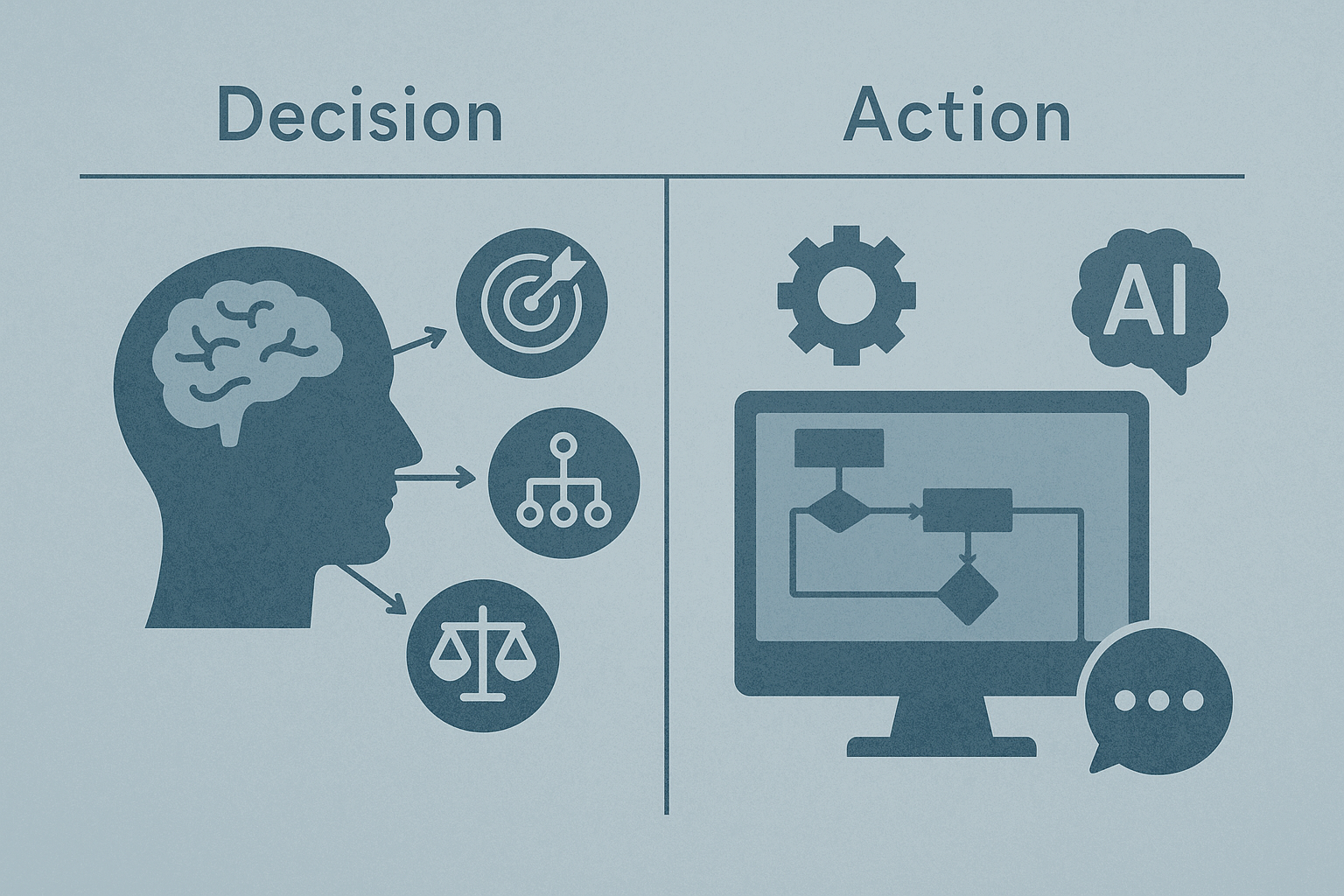
In this post, I want to offer a clearer way to think about that question. Drawing on recent research with colleagues, I propose a framework that breaks down jobs into their smallest units — skills — and then divides each skill into two distinct components: decision-making and execution. This distinction, I argue, is essential to understanding where humans still matter, how AI is reshaping labor, and what we should be measuring, teaching, and building toward.
If we can’t say what a job is, we can’t reason about what AI is replacing.
The Wrong Debate
Much of the public debate still hinges on a narrow question: Will AI replace us, or will it help us? But this framing misses the deeper structural shift underway. It treats jobs as flat, undifferentiated collections of tasks, as if replacing a few steps is equivalent to automating the whole. In reality, most jobs are complex systems of judgment, adaptation, and execution. And not all parts of that system are equally exposed to AI. If we want to understand how work is changing — and what skills will remain valuable — we need a more granular lens.
Ada’s Shift
Consider Ada, a mid-level software engineer. Just a few years ago, her day revolved around writing code, debugging features, documenting functions, and reviewing pull requests. Today, GitHub Copilot writes much of the scaffolding. GPT drafts her documentation. Internal models flag bugs before she sees them. Her technical execution has been accelerated — even outsourced — by AI. But her job hasn’t disappeared. It has shifted.
What Ada does has changed. What Ada is responsible for has not.
What matters now is whether Ada can decide what to build, why it matters, how to navigate tradeoffs that aren’t in the training data — and crucially, whether the result is even correct. Her value no longer lies in execution — it lies in judgment and verification. This isn’t just a shift in what she does — it’s a shift in what makes her valuable. Execution can be delegated. Judgment cannot.
The Real Divide
Ada’s story isn’t just a sign of change—it’s a window into the deeper structure of modern work. In our research, we argue that to understand how AI is reshaping labor, we need to go beyond jobs and tasks, and examine the composition of skills themselves
Action-level skills: executing plans through tools, language, or procedures
This distinction is foundational to our framework. It allows us to model worker capabilities and job demands more precisely. And once you see the split, it’s everywhere.
A doctor uses AI to flag anomalies in a scan — but must decide when to intervene, and why.
An analyst uses GPT to draft a report — but must decide which story the data tells.
A teacher uses AI to generate exercises — but must decide how to adapt them for a struggling student.
A programmer uses Copilot to write code — but must decide what to build, how to build it, and in what language, architecture, or paradigm.
AI acts. Humans decide. That’s the frontier.
This isn’t a cosmetic difference. It’s a deep structural boundary — one that shapes who adds value, who adapts, and who gets displaced.
The distinction between decision and action is becoming the new fault line in labor.
A New Lens on Success
This structure isn’t just descriptive—it makes success measurable. We model each worker using an ability profile that captures their expected strength and variability at each subskill. Given a job’s subskill demands, we can compute the probability of success—a quantitative match between a worker’s capabilities and a job’s needs. This also lets us explore how training, support, or AI tools can shift that success rate—and identify where small changes make a big difference.
One of our key findings is that decision-level skills often act as a bottleneck: small improvements can trigger phase transitions, where success probability jumps sharply rather than smoothly. A little more judgment can be worth far more than a lot more action.
We also show how merging two workers—or pairing a worker with an AI system—can significantly boost job success by combining complementary skills. This framework yields four canonical pairings—each capturing a mode of human or hybrid productivity:
Strong decision + strong action: the ideal worker, high success probability.
Strong decision + weak action: can be aided by AI to improve execution.
Weak decision + strong action: needs human or institutional support to frame and evaluate problems.
Weak decision + weak action: unlikely to succeed without extensive support or retraining.
This pairing framework also models human-AI collaboration. AI tools excel in action-level tasks, reducing execution noise. But they cannot compensate for poor decisions. Conversely, humans with decision strength but noisy action skills can leverage AI to execute more reliably.
AI can make your actions sharper. But it takes another human—or a better-trained self—to make your decisions wiser.
Rethinking Upskilling
Most upskilling initiatives focus on teaching people how to use tools — how to code in Python, use Excel, write better prompts. But these are action-level skills. They train people to do — not to decide. And as AI becomes more fluent in these domains, such training risks becoming obsolete even faster.
What our model shows is that the most durable leverage comes from strengthening decision-level abilities: learning how to formulate the right problem, evaluate competing goals, and adapt strategy under uncertainty. These skills are harder to teach, harder to measure — but they’re also harder to replace.
Reskilling should not mean trading one automatable task for another. It should mean elevating workers into roles where human judgment is indispensable — and building the scaffolding to support that transition.
The goal isn’t to out-code AI. It’s to out-decide it.
But understanding skill composition isn’t just useful for support or upskilling—it changes how we identify and select talent in the first place.
Beyond the Average: Hiring for Complements, Not Proxies
Traditional hiring often relies on blunt proxies—credentials, test scores, résumé keywords—that collapse a person’s skill into a single metric. But real talent is rarely uniform. Someone may struggle with polish but excel at solving hard problems. Another may be smooth in execution but shallow in judgment. Conventional systems force institutions to average across these traits—hiring for perceived overall competence rather than true fit.
Our framework breaks that bind. By distinguishing decision-level and action-level abilities, and modeling how they combine, we can identify complementary strengths—either across people or in partnership with AI. This makes it possible to spot a high-judgment candidate with messy execution and pair them with tools that stabilize output. Or to recognize an efficient executor who thrives when decisions are pre-structured by a manager or teammate.
You no longer have to bet on the average. You can hire for the right complement.
This shift doesn’t just improve hiring. It makes evaluation more precise, support more targeted, and teams more balanced. It also disrupts the performative incentives of current systems, where polish often trumps insight, and fluency overshadows depth. If we can build systems that recognize decision strength—even in the absence of perfect execution—we can unlock talent that today gets overlooked.
Designing for the Future of Work
Ada’s story is only the beginning. Her challenge—learning how to decide, not just how to do—is quickly becoming the central challenge for institutions.
The AI wave isn’t just increasing efficiency. It’s reshaping the anatomy of work, separating action from decision, and forcing us to ask: what remains uniquely human?
Economist Daron Acemoglu argues that the most dangerous trend in recent technological history isn’t automation itself—it’s the way we’ve used automation to displace workers rather than augment them. Over the past few decades, many technologies have replaced mid-skill jobs without meaningfully improving productivity. The result: wage stagnation, rising inequality, and a polarized labor market. Acemoglu’s call is clear—we need to redirect innovation toward task-augmenting technologies that enhance human capability rather than erode it.
Our framework offers a concrete way to act on that vision. By distinguishing between decision- and action-level skills, and modeling how they interact with AI, we can design technologies—and institutions—that truly support human strengths.
But the real challenge is not theoretical. It’s institutional.
If we continue to train, hire, and evaluate people based on action-level outputs, we will misread talent, mistrain workers, and misdesign systems. Worse, we will cede the future of work to automation by default—not because AI is more capable, but because we forgot how to measure what humans uniquely contribute.
Our model not only reframes how we think about work, but also offers a practical tool for institutions. By enabling fine-grained evaluations along decision- and action-level dimensions, it allows for more accurate assessments—not just in hiring, but also in upskilling, promotions, task allocation, and even layoff decisions. Instead of collapsing a worker’s abilities into a single metric, we can now ask: where does their judgment shine? Where is support or augmentation most effective?
We need tools, metrics, and institutions that can recognize decision-level excellence—not just output volume. Otherwise, we’ll keep mistaking speed for insight, and productivity for progress. That means rethinking how we evaluate students, support workers, and guide innovation. It means building systems that value judgment, verification, ethical reasoning, and strategic adaptation—the things that don’t show up in a prompt but define good decisions.
The question is no longer whether humans have a role. The question is whether we’re designing for it.
This is the work ahead. And we’ll need to be as thoughtful about decisions as we’ve been clever with tools.
This essay draws on a forthcoming paper, A Mathematical Framework for AI-Human Integration in Work, by L. Elisa Celis, Lingxiao Huang, and Nisheeth K. Vishnoi, to appear at ICML 2025. You can read the full paper here: https://arxiv.org/abs/2505.23432
How algorithms gained decision-making power—and what they replaced
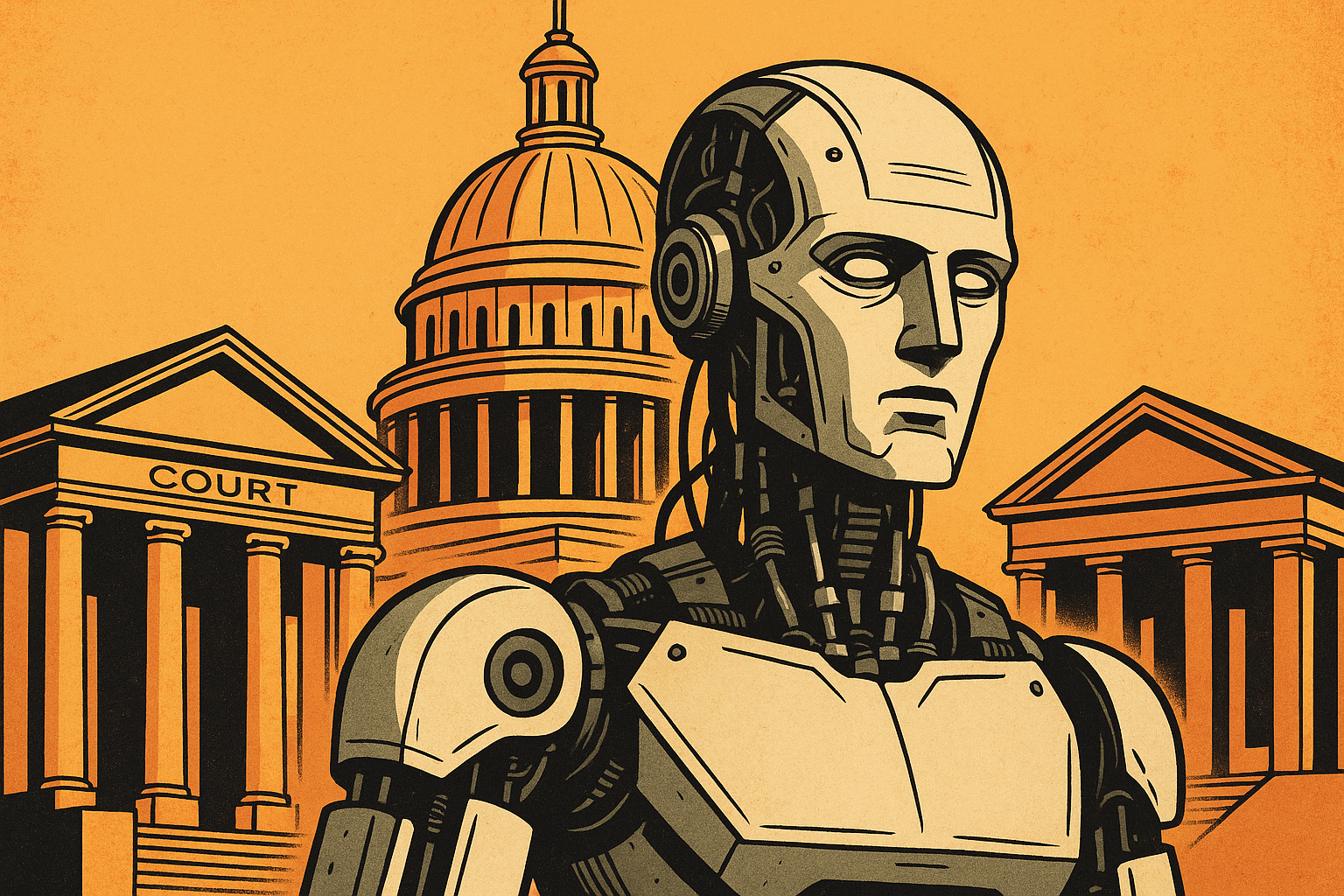
In my previous post, I argued that AI systems—particularly those built on large models—are no longer just tools. They are becoming institutions.
Not in the legal sense. But in function.
They structure judgment, allocate opportunity, and shape legitimacy, just as courts, schools, or hiring boards once did.
This post explains what that claim means in practice. Not through abstraction, but through concrete, recent events.
When I say “AI,” I don’t mean a single system. I mean a distributed set of deployed models—language models, scoring tools, surveillance networks—that now act with institutional authority in many parts of life.
What makes something an institution?
Institutions are not just buildings or bureaucracies. They are systems of trust and authority.
They determine:
Who gets hired.
Who is heard.
Who is protected or punished.
And who gets left out.
They operate over time. They are accepted, contested, appealed to.
And now, AI systems are being inserted into exactly these roles.
From automation to judgment
A2025 Australian study led by researchers at the University of Technology Sydney found that AI hiring systems widely used in the private sector were systematically discriminating against women, people with disabilities, and candidates with non-standard accents.
Some systems analyzed facial expressions during interviews, penalizing applicants who didn’t smile “appropriately.” Others struggled with speech patterns from non-native English speakers, or penalized pauses—often flagging neurodivergent candidates as “low energy.” Most troublingly, many of these systems were trained on U.S. resumes and corporate data, leading to cultural mismatches in Australian hiring. (source)
The AI didn’t just screen résumés. It functioned as a hiring gatekeeper, shaping who advanced and who disappeared from consideration.
Prediction becomes policy
Los Angeles County recently launched a machine learning initiative called PREVENT to identify individuals most at risk of becoming homeless.
The system analyzes data across health records, public benefits, and eviction filings. It flags individuals for early intervention, offering rental assistance or job support—before they lose housing. (source) In a world of limited social services, that score can determine who gets help and who doesn’t. Prediction becomes a gateway.
The model becomes a triage system, quietly encoding institutional priorities.
From oversight to automation
In 2024, New Orleans police used over 200 facial recognition cameras run by a private nonprofit to monitor and arrest suspects in real time—without public disclosure.
The system sent alerts with suspect identities and GPS locations directly to officers’ phones, resulting in at least 34 arrests—some for nonviolent offenses. (source)
This surveillance violated a 2022 city ordinance, which limited facial recognition use to violent crime investigations. Yet the system operated with full effect, effectively automating discretionary policing without accountability.
AI governs speech
For instance, in 2024, TikTok laid off hundreds of human moderators and leaned heavily on AI to enforce its content policies.
Over 150 million videos were removed in one quarter alone—more than 80% flagged automatically. (source) Yet users have long noted that AI moderation lacks nuance, often taking down posts about trauma, race, or mental health from marginalized communities. In response, creators began using “algospeak” (e.g., “unalive” instead of “suicide”) to evade takedowns.
When AI moderates, it doesn’t just enforce guidelines. It structures what can be said and what is suppressed.
And this is just the tip of the proverbial iceberg.
The power without the process
These systems don’t gain authority from constitutional law or public oversight.
They derive it from performance (or efficiency):
“It works.”
“It scales.”
“It predicts better than humans.”
But once adopted, their outputs become binding. And there is often no one to appeal to.
The judgment is made before the human arrives. And often, the human defers to it.
Why this matters
When institutions were flawed, we could appeal. Argue. Dispute. Reform.
With AI systems, we often don’t know the decision was made. Or we mistake it for truth.
That’s what I mean when I say: AI systems are becoming institutions. Not because they were designed to be—but because they function like ones.
They make judgments. They allocate resources. They shape legitimacy. But unlike human institutions, they offer no explanation, no transparency, and no path for redress.
How machines are reshaping legitimacy, agency, and the structure of society
We often speak of AI as a tool—as something humans will use to become more productive, more creative, more efficient. But this framing misses something deeper.
AI is not just a tool. It is becoming an institutional force.
It already decides who is hired, who is approved for loans, which students are flagged for intervention, and what news people see. In many domains, AI doesn’t assist decision-makers—it replaces them, or constrains their choices within a narrow band of “optimized” outcomes.
This is no longer science fiction. It is our administrative present.
As a computer scientist, I’ve long worked on algorithms: their structure, efficiency, and fairness. But in the presence of AI, a new reality is emerging—one in which systems built from data and optimization objectives become gatekeepers of opportunity. Unlike traditional institutions, these systems do not derive legitimacy from democratic deliberation, legal precedent, or public accountability. They derive it from performance—often defined narrowly, statistically, and in ways that resist scrutiny.
We are now confronting urgent questions:
– When AI models mediate access to education or employment, what and whose values are embedded in the model?
– How does agency change when effort is filtered through a predictive lens trained on historical bias?
– What happens when institutions outsource moral judgment to machines?
– What kinds of futures are erased when AI systems optimize for what’s already worked?
This newsletter—Algorithms and Society—is my way of thinking through these tensions: structurally, mathematically, and morally.
I will write about:
– Fairness and bias in algorithmic systems, especially when AI is used to select or filter
– The evolving meaning of merit, effort, and agency in AI-mediated institutions
– How feedback loops between predictions and behavior can amplify inequality
– What it might mean to design AI systems for democratic legitimacy, not just accuracy
– And what the future of humanity—from work, to creativity, to intuition—might look like in the age of AI
This is not a place for hype, nor for alarmism. It’s a space to think clearly about what AI is doing to the systems we depend on—and how we might intervene.
If you’re a researcher, technologist, policymaker, or simply someone trying to understand how the future is being shaped—welcome.
Let’s ask the hard questions before the defaults become destiny.