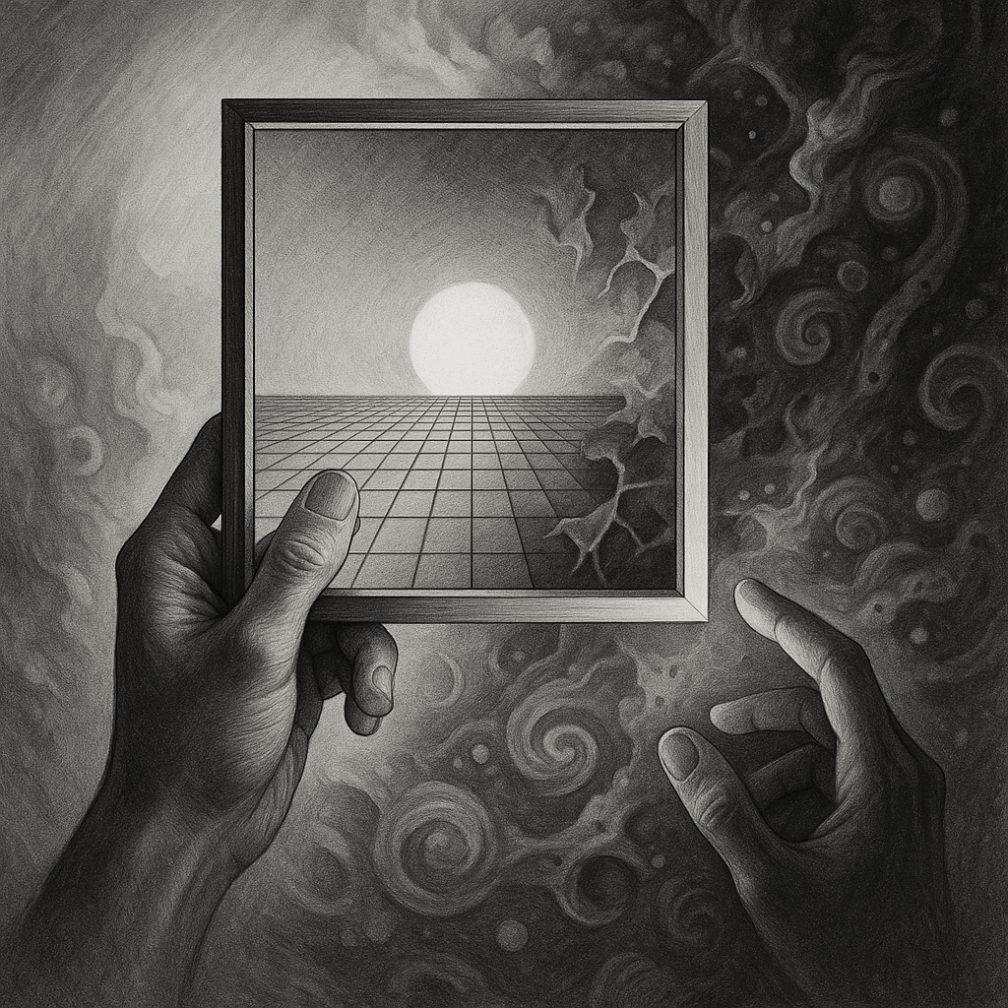
When intelligence turns inward, it creates the structure in which suffering can arise
When Light Meets Mind
In 1930, Berlin, two men sat across from each other. I’ve read the transcript more times than I can count. Not because it resolved anything, but because it kept echoing through my life.
You had Albert Einstein: the rationalist, the physicist. The man who redefined time, and connected matter and energy, gravity and spacetime. He saw the universe as vast, governed by elegant equations: something to be uncovered, mapped, and trusted.
And then Rabindranath Tagore: the poet, the mystic, the one who saw the inner world. But more than that, he believed that consciousness was not an afterthought in the cosmos. It was central. He wrote songs that became anthems, plays that folded myth into philosophy. His essays held reason and reverence in the same hand.
Where Einstein searched for equations and invariants, Tagore searched for meaning. He accepted science; he insisted that without awareness, it was incomplete. That the world, however beautiful, is only illuminated through the light of mind.
They spoke quietly, these two Nobel laureates, gently trying to name what is real.
Einstein put it plainly: “I believe in the external world, independent of the perceiving subject.”
Tagore’s response was just as clear: “The world is a human world; its reality is relative to our consciousness.”
On the surface, it sounded like a classic philosophical disagreement. But it felt like something more. As if two orientations, objective structure and lived experience, had paused long enough to listen, without declaring a winner.
I used to read that conversation purely as a question of truth: Is there a world independent of us, or is the world, at its core, ours?
But over time, it stopped feeling abstract. It began to weigh on me, in quiet ways I couldn’t always name.
There were losses, some that shook me more than I expected. And then the birth of my children cracked open a terrain I had not known was missing. Both experiences, in their own way, made me question how I had come to know the world, and what kind of knowledge mattered.
The structure I had spent years building, through science and mathematics, was solid. It gave me clarity. It gave me recognition. But it stopped short of certain truths I could now feel pressing in from the edges. Truths not about the world, but about the self that was trying to understand it.
And I began to notice something unsettling: the same intelligence that helped me understand the world could also make me feel lost within it. Not in the usual scientific way, where each answer opens new questions. That rhythm was familiar, even comforting. This was something different. A quieter unease. As if my way of knowing: analytical, recursive, and precise, had become part of the very trap.
I began to see a pattern: the mind’s ability to turn inward, to reflect on itself, could both elevate and entangle it. That reflection could open not just insight, but ache.
Tagore’s words, “The world is a human world”, started to echo differently. Not just as a metaphysical claim, but as a lived one. As a statement about what happens when consciousness turns in on itself. When intelligence doesn’t just observe the world, but begins to simulate its role within it. To model. To track. To reflect. And so I found myself asking: If intelligence brings light to the world, what happens when that light bends inward? What does it illuminate? And what does it burn?
This essay follows that question: tracing how recursive self-modeling, across biology, culture, and computation, opens the door not only to creativity and empathy, but to suffering. Along the way, I turn to contemplative traditions and computational framing to propose a deeper account: that suffering emerges when valuation becomes identity, when the mind tries to optimize a moving target that it has mistaken for itself.
Read the full essay by subscribing (for free) to The Intelligence Loop.